


COMEDK · Chemistry · 17. Solutions
If the depression in freezing point of an aqueous solution containing a solute, which is neither dissociated nor associated, is \(\mathrm{a} \mathrm{K}\) with \(\mathrm{K}_{\mathrm{f}}=\mathrm{b ~ K ~ k g ~ m o l}{ }^{-1}\), what would be the elevation in boiling point \((\mathrm{X})\) for this solution if its \(\mathrm{K}_{\mathrm{b}}=\mathrm{\mathrm { ~K } \mathrm { ~K } \mathrm { ~kg } \mathrm { ~mol }}{ }^{-1}\) ?
- A \(\mathrm{X}=\mathrm{c} \times \dfrac{b}{a}\)
- B \(X=c \times \dfrac{a}{b}\)
- C \(\mathrm{X}=2 \mathrm{c} \times \dfrac{b}{a}\)
- D \(X=c \times \dfrac{a}{2 b}\)
Answer & Solution
Correct Answer
(B) \(X=c \times \dfrac{a}{b}\)
Step-by-step Solution
Detailed explanation
The depression in freezing point is given by the formula \(\Delta T_f = K_f \times m\), where \(m\) is the molality of the solution. Given \(\Delta T_f = a\) and \(K_f = b\), we have \(a = b \times m\), which implies \(m = \dfrac{a}{b}\). The elevation in boiling point is given…
See the Complete Solution
Get step-by-step explanations for this and 2.5 Lakh+ more JEE, NEET & CET questions.
- Unlock all solutions
- Practice the full chapter
- Track accuracy across PYQs
4.8 rated on Google Play · 14,000+ reviews
More questions from Chemistry
- A dilute solution of an ionic compound \(\mathrm{A}_3 \mathrm{~B}\) has an Osmotic pressure which is 6 times that of \(0.02 \mathrm{M}\) \(\mathrm{MgCl}_2\). What is the molar concentration of \(\mathrm{A}_3 \mathrm{~B}\) assuming that it undergoes complete dissociation in water?COMEDK 2025 Medium
- Which of the following complex show optical isomerism?
(i) cis- \(\left[\mathrm{COCl}(\mathrm{en})_2\left(\mathrm{NH}_3\right)\right]^{2+}\)
(ii) cis- \(\left[\mathrm{CrCl}_2(\mathrm{ox})_2\right]^{3-}\)
(iii) cis- \(\left[\mathrm{CO}(\mathrm{en})_2 \mathrm{Cl}_2\right] \mathrm{Cl}\)
(iv) cis \(\left\{\mathrm{CO}\left(\mathrm{NH}_3\right)_4 \mathrm{Cl}_2\right]^{+}\)COMEDK 2023 Medium - Two liquids A and B form an ideal solution. At 300 K , the vapour pressure of pure A and pure B are \(8 \times 10^3 \mathrm{~Pa}\) and \(12 \times 10^3 \mathrm{~Pa}\) respectively. If the solution has 40 mole percent of \(A\), the composition of \(A\) and \(B\) in the vapour phase is:COMEDK 2025 Medium
- The \(\mathrm{E}^{\circ}\) values of \(\mathrm{A} . \mathrm{B}\) and \(\mathrm{C}\) are given. Which element/(s) is/(are) good for coating the surface of iron to prevent corrosion?
Given: \([\mathrm{E}_{\mathrm{Fe}^{2+} / \mathrm{Fe}}^0=-0.44 \mathrm{~V} ; \quad \mathrm{E}_{\mathrm{A}^{2+} / \mathrm{A}}^0=-2.37 \mathrm{~V} ; \quad \mathrm{E}_{\mathrm{B}^{2+} / \mathrm{B}}^0=-0.15 \mathrm{~V} ; \quad \mathrm{E}_{\mathrm{C}^{2+} / \mathrm{C}}^0=+0.34 \mathrm{~V}]\)COMEDK 2024 Medium - The conjugate acid of \(\mathrm{NH}_{2}^{-}\)isCOMEDK 2012 Easy
- What would be the molarity of one litre solution of \(22.2 \mathrm{~g}\) of \(\mathrm{CaCl}_{2}\) ?COMEDK 2021 Medium
More PYQs from COMEDK
- If \(f(x)=\left\{\begin{array}{l}m x+1, x \leq \dfrac{\pi}{2} \\ \sin x+n, x>\dfrac{\pi}{2}\end{array} \quad\right.\) is continuous at \(x=\dfrac{\pi}{2}\), thenCOMEDK 2025 Easy
- A complex compound in which the oxidation number of a metal is zero, isCOMEDK 2017 Easy
- A gas is taken through the cycle \(A \rightarrow B \rightarrow C \rightarrow A\), as shown in figure. What is the net work done by the gas?
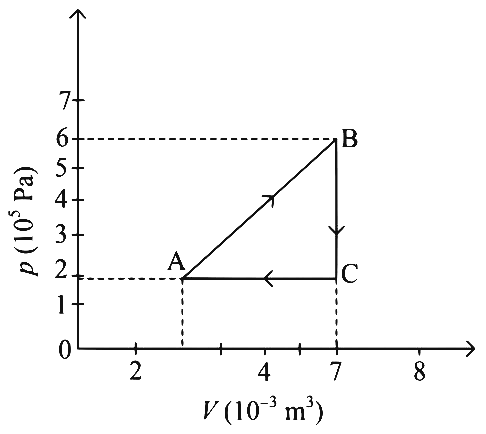 COMEDK 2023 Medium
 -
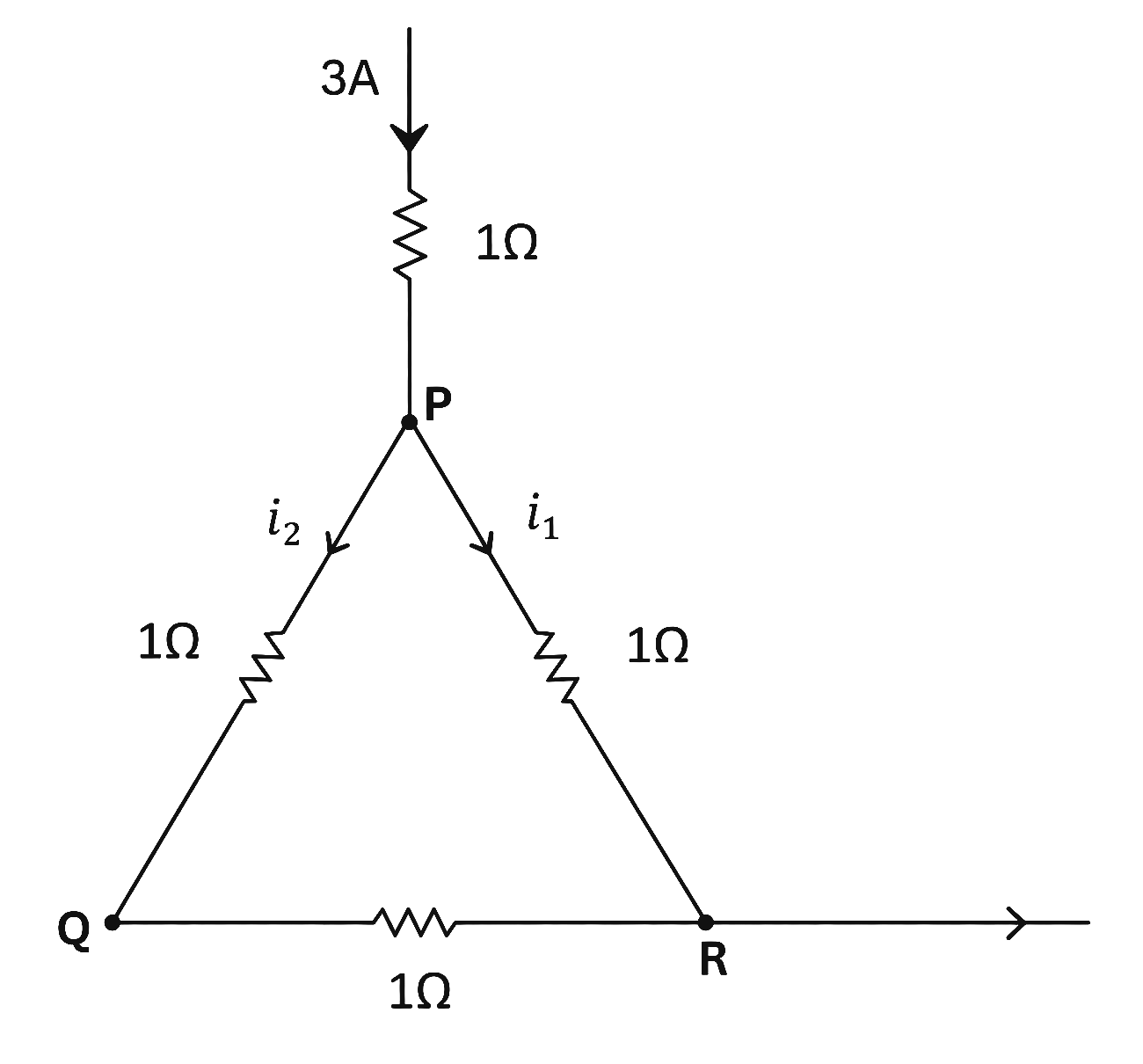
A current of 3A enters one vertex P of an equilateral triangle PQR having three resistors of \(1\Omega\) each forming the sides of the equilateral triangle as shown. The value of \(i_2\) in amperes is:COMEDK 2026 Medium - Which of the following is the simplest form of the expression \(\tan^{-1}\left(\dfrac{\sqrt{1+x^2} - 1}{x}\right)\) where \(x \neq 0\)COMEDK 2026 Medium
- Find the correct matches.
\(\begin{array}{|l|l|l|l|} \hline \text{A} & \mathrm{Cr}_2 \mathrm{O}_7^{2-} & \mathrm{P} & \text{is predominantly a basic compound.} \\ \hline \text{B} & \mathrm{FeCr}_2 \mathrm{O}_4 & \mathrm{Q} & \text{is predominantly an acidic compound.} \\ \hline \text{C} & \mathrm{CrO}_3 & \mathrm{R} & \text{forms yellow chromate on reaction with } \mathrm{Na}_2 \mathrm{CO}_3 \text{ in air.} \\ \hline \text{D} & \mathrm{CrO} & \mathrm{S} & \text{is interconvertible with } \mathrm{MO}_4^{2-} \text{ depending on the pH of the medium.} \\ \hline \end{array}\)COMEDK 2025 Medium