


COMEDK · Chemistry · 14. Hydrocarbons
Identify the reagents to be used to complete the given reaction.
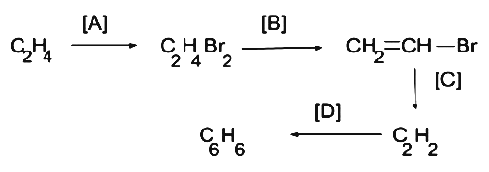
- A \(\mathrm{A}=\mathrm{HBr} \quad \mathrm{B}=\) alc. \(\mathrm{KOH} \quad \mathrm{C}=\mathrm{CaC}_2 \quad \mathrm{D}=\) Red hot Ni tube
- B \(\mathrm{A}=\mathrm{Br}_2 / \mathrm{CCl}_4 \quad \mathrm{~B}=\) aq. \(\mathrm{KOH} \quad \mathrm{C}=\) Conc. \(\mathrm{H}_2 \mathrm{SO}_4 \quad \mathrm{D}=\) Red hot Cu tube
- C \(\mathrm{A}=\mathrm{CHBr}_3 \quad \mathrm{~B}=\) aq. \(\mathrm{KOH} \quad \mathrm{C}=\) Conc. \(\mathrm{HI} \quad \mathrm{D}=\) Red hot Pd tube
- D \(\mathrm{A}=\mathrm{Br}_2 / \mathrm{CCl}_4 \quad \mathrm{~B}=\) alc. \(\mathrm{KOH} \quad \mathrm{C}=\mathrm{NaNH}_2 \quad \mathrm{D}=\) Red hot Fe tube
Answer & Solution
Correct Answer
(D) \(\mathrm{A}=\mathrm{Br}_2 / \mathrm{CCl}_4 \quad \mathrm{~B}=\) alc. \(\mathrm{KOH} \quad \mathrm{C}=\mathrm{NaNH}_2 \quad \mathrm{D}=\) Red hot Fe tube
Step-by-step Solution
Detailed explanation
The reaction sequence is as follows: Step [A]: Ethylene (\(C_2H_4\)) reacts with \(Br_2/CCl_4\) to form 1,2-dibromoethane (\(CH_2Br-CH_2Br\)). Step [B]: 1,2-dibromoethane undergoes dehydrohalogenation using alcoholic \(KOH\) to form vinyl bromide (\(CH_2=CH-Br\)). Step [C]:…
See the Complete Solution
Get step-by-step explanations for this and 2.5 Lakh+ more JEE, NEET & CET questions.
- Unlock all solutions
- Practice the full chapter
- Track accuracy across PYQs
4.8 rated on Google Play · 14,000+ reviews
More questions from Chemistry
- Both reactions (i) and (ii) give the same compound X as the major product. Identify X
(i). 3-Methylbut-1-ene \(+\mathrm{HCl} \rightarrow \mathrm{X}\)
(ii). Neopentyl alcohol \(+\mathrm{HCl}\left(\right.\) anh. \(\left.\mathrm{ZnCl}_2\right) \rightarrow \mathrm{X}\)COMEDK 2025 Medium - Angular momentum of an electron in the \(n\)th orbit of hydrogen atom is given byCOMEDK 2013 Easy
- Consider the following reaction
Propyne \(+\mathrm{CH}_3 \mathrm{MgBr} \xrightarrow{\text { dry ether }} \mathrm{X}\)
Identify ' \(X\) ' from the following.COMEDK 2025 Medium - \(6 \mathrm{~g}\) of urea is dissolved in \(90 \mathrm{~g}\) of water. Relative lowering of vapour pressure isCOMEDK 2019 Medium
- The rate of appearance of bromine is related to the disappearance of bromide ion in the equation given below is:
\(\mathrm{BrO}_3^{-} \text {(aq) }+5 \mathrm{Br}^{-} \text {(aq) }+6 \mathrm{H}^{+} \rightarrow 3 \mathrm{Br}_2(\mathrm{l})+3 \mathrm{H}_2 \mathrm{O}(\mathrm{l})\)COMEDK 2024 Medium - When 1 mole of \(\mathrm{O}_2\) and 1 mole of ammonia are made to react in the reaction,
\(4 \mathrm{NH}_3(\mathrm{~g})+5 \mathrm{O}_2(\mathrm{~g}) \rightarrow 4 \mathrm{NO}(\mathrm{g})+6 \mathrm{H}_2 \mathrm{O}(\mathrm{g})\)COMEDK 2024 Medium
More PYQs from COMEDK
- The maximum kinetic energy of emitted electrons in a photoelectric effect does not depend uponCOMEDK 2018 Easy
- What is the standard electrode potential at 298 K for the reaction: \(\mathrm{Cu}^{2+}+1 \mathrm{e}-\rightarrow \mathrm{Cu}^{+1}\) ?
Given: \(\mathrm{E}_0 \mathrm{Cu}^{+1} / \mathrm{Cu}=0.5 \mathrm{~V} \quad \& \quad \mathrm{E}_0 \mathrm{Cu}^{+2} / \mathrm{Cu}=0.335 \mathrm{~V}\)COMEDK 2025 Medium - Which one of the following coordination entity is chiral?COMEDK 2015 Hard
- An object is placed at a distance of \(12 \mathrm{~cm}\) from a convex lens on its principal axis and a virtual image of certain size is formed. If the object is moved \(4 \mathrm{~cm}\) away from the lens, a real image of the same size as that of the virtual image is formed. The focal length of the lens in \(\mathrm{cm}\) isCOMEDK 2024 Medium
- The maximum value of \(\left(\frac{1}{x}\right)^{2 x^{2}}\) isCOMEDK 2018 Easy
- Which of the following compounds have the same value of van't Hoff s factor \((i)\) as that of \(\mathrm{Al}_{2}\left(\mathrm{SO}_{4}\right)_{3}\) ?COMEDK 2015 Easy