


COMEDK · Chemistry · 19. Chemical Kinetics
For the reaction \(\mathrm{Cl}_{2(\mathrm{~g})}+2 \mathrm{NO}_{(\mathrm{g})} \rightarrow 2 \mathrm{NOCl}_{(\mathrm{g})}\), the following data was obtained:
| Experiment No. | Initial concentration of \(Cl_2\) (M) | Initial concentration of NO (M) | Initial reaction rate (M/min) |
|---|---|---|---|
| I | 0.15 | 0.15 | 0.60 |
| II | 0.30 | 0.15 | 1.20 |
| III | 0.15 | 0.30 | 2.40 |
| IV | 0.25 | 0.25 | 2.78 |
Identify the order of the reaction with respect to \(\mathrm{Cl}_2, \mathrm{NO}\) and the value of Rate constant.
- A \(\text { Order with respect to } \mathrm{Cl}_2=0 \quad \text { Order with respect to } \mathrm{NO}=1 \quad \mathrm{k}=8.0 \mathrm{~min}^{-1}\)
- B \(\text { Order with respect to } \mathrm{Cl}_2=1 \quad \text { Order with respect to } \mathrm{NO}=1 \quad \mathrm{k}=26.66 \mathrm{~mol}^{-1} \mathrm{Lmin}^{-1}\)
- C \(\text { Order with respect to } \mathrm{Cl}_2=2 \quad \text { Order with respect to } \mathrm{NO}=1 \quad \mathrm{k}=355.5 \mathrm{~mol}^{-2} \mathrm{~L}^2 \mathrm{~min}^{-1}\)
- D \(\text { Order with respect to } \mathrm{Cl}_2=1 \quad \text { Order with respect to } \mathrm{NO}=2 \quad \mathrm{k}=177.7 \mathrm{~mol}^{-2} \mathrm{~L}^2 \mathrm{~min}^{-1}\)
Answer & Solution
Correct Answer
(D) \(\text { Order with respect to } \mathrm{Cl}_2=1 \quad \text { Order with respect to } \mathrm{NO}=2 \quad \mathrm{k}=177.7 \mathrm{~mol}^{-2} \mathrm{~L}^2 \mathrm{~min}^{-1}\)
Step-by-step Solution
Detailed explanation
The rate law for the reaction is given by \(Rate = k[Cl_2]^x [NO]^y\). Using data from Experiment I and II: \(0.60 = k(0.15)^x (0.15)^y\) \(1.20 = k(0.30)^x (0.15)^y\) Dividing the two equations:…
See the Complete Solution
Get step-by-step explanations for this and 2.5 Lakh+ more JEE, NEET & CET questions.
- Unlock all solutions
- Practice the full chapter
- Track accuracy across PYQs
4.8 rated on Google Play · 14,000+ reviews
More questions from Chemistry
- \(15 \mathrm{~g}\) of \(\mathrm{CaCO}_3\) completely reacts withCOMEDK 2023 Easy
- Identify the product \((\mathrm{Y})\) formed in the given reaction and the name of the reaction where \((\mathrm{X}) \rightarrow(\mathrm{Y})\).
\(\mathrm{C}_6 \mathrm{H}_5 \mathrm{NH}_2 \xrightarrow[\boldsymbol{H C l}, \mathrm{0}^{\circ} \boldsymbol{C}]{\boldsymbol{N a N O}_2}(\mathrm{~W})+\mathrm{KI} \longrightarrow(\mathrm{X}) \xrightarrow[\text { dry ether }]{\boldsymbol{N a}(s)}(\mathrm{Y})\)COMEDK 2025 Medium - If same type of atoms are packed in hexagonal close packing and cubic close packing separately, thenCOMEDK 2015 Easy
- From the following compounds, identify the one which is most acidic.
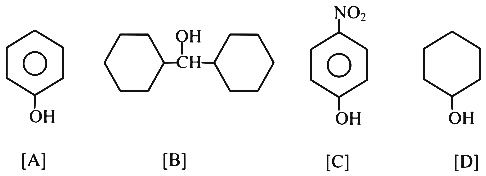 COMEDK 2024 Medium
 - The Lyman series of hydrogen spectrum lies in which regionCOMEDK 2021 Medium
- Two statements, one Assertion (A) and the other Reason (R) are given. Choose the correct option.
Assertion: Compound \([\mathrm{X}]\) reacts with Hydrazine in presence of \(\mathrm{KOH} /\) Glycol to form the product \([\mathrm{Y}]\).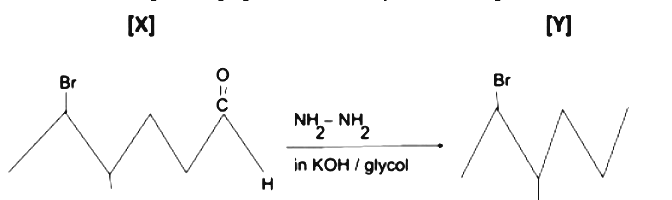 COMEDK 2025 Medium
More PYQs from COMEDK
- Which one of the following compounds will give a yellow precipitate when reacted with \(\mathrm{I}_2 / \mathrm{NaOH}\) ?COMEDK 2025 Easy
- Which physical quantity has the unit joule / tesla?COMEDK 2025 Easy
- The points of intersection of circles \((x+1)^2+y^2=4\) and \((x-1)^2+y^2=9\) are \((a, \pm b)\), then \((a, b)\) equals toCOMEDK 2023 Easy
- If \(A=\{4,5,9\}\) and \(B=\{1,2,4,6\}\), then \((A \cup B) \cap(B-A)\) isCOMEDK 2024 Easy
- Among the following, which is not according to the property indicated against it?COMEDK 2024 Medium
- A capacitor of capacitance \(4 \mu \mathrm{~F}\) is charged to a potential of 24 V and then connected in parallel to an uncharged capacitor of capacitance \(6 \mu \mathrm{~F}\). The final potential difference across each capacitor will be:COMEDK 2025 Medium