


COMEDK · Chemistry · 19. Chemical Kinetics
For a reaction \(5 X+Y \rightarrow 3 Z\), the rate of formation of \(Z\) is \(2.4 \times 10^{-5} \mathrm{~mol} \mathrm{~L}^{-1} \mathrm{~s}^{-1}\) Calculate the average rate of disappearance of \(\mathrm{X}\).
- A \(4.0 \times 10^{-5} \mathrm{~mol} \mathrm{~L}^{-1} \mathrm{~s}^{-1}\)
- B \(4.8 \times 10^{-7} \mathrm{~mol} \mathrm{~L}^{-1} \mathrm{~s}^{-1}\)
- C \(12.0 \times 10^{-5} \mathrm{~mol} \mathrm{~L}^{-1} \mathrm{~s}^{-1}\)
- D \(13.33 \times 10^{-6} \mathrm{~mol} \mathrm{~L}^{-1} \mathrm{~s}^{-1}\)
Answer & Solution
Correct Answer
(A) \(4.0 \times 10^{-5} \mathrm{~mol} \mathrm{~L}^{-1} \mathrm{~s}^{-1}\)
Step-by-step Solution
Detailed explanation
The rate of reaction for the given chemical equation \(5X + Y \rightarrow 3Z\) is expressed in terms of the rates of disappearance of reactants and the rate of formation of products as follows:…
See the Complete Solution
Get step-by-step explanations for this and 2.5 Lakh+ more JEE, NEET & CET questions.
- Unlock all solutions
- Practice the full chapter
- Track accuracy across PYQs
4.8 rated on Google Play · 14,000+ reviews
More questions from Chemistry
- The standard reduction potentials of \(\mathrm{Zn}\) and \(\mathrm{Ag}\) in water at \(298 \mathrm{~K}\) are,
\(\begin{aligned}
\mathrm{Zn}^{2+}+2 e^{-} \rightleftharpoons \mathrm{Zn}, & E^{\circ}=-0.76 \mathrm{~V} \\
\text { and } \quad \mathrm{Ag}^{+}+e^{-} \rightleftharpoons \mathrm{Ag} ; & E^{\circ}=+0.80 \mathrm{~V}.
\end{aligned}\)
Which of the following reactions take place?COMEDK 2013 Easy - Amino acids exist as zwitter ions atCOMEDK 2014 Easy
- The volume of \(10 \mathrm{~N}\) and \(4 \mathrm{~N}\) HCl required to make 1 litre of \(7 \mathrm{~N} \mathrm{HCl}\) areCOMEDK 2020 Hard
- Match the Hormones listed in Column I with their characteristics listed in Column II
No. Hormone No. Characteristics A Adrenal Cortex P Mediates responses to external stimuli. B Epinephrine Q Steroid hormone. C Estrogen R Iodinated derivative of Tyrosine amino acid. D Thyroxine S Its malfunction causes Addison's disease. COMEDK 2024 Easy - Which of the following haloalkanes will give more than one isomeric product, on being heated with alc. KOH ?COMEDK 2025 Medium
- If the equilibrium constant for \(\text{N}_{2(g)} + \text{O}_{2(g)} \rightleftharpoons 2\text{NO}_{(g)}\) is 49
The equilibrium constant for the reaction \(\text{NO}_{(g)} \rightleftharpoons \dfrac{1}{2}\text{N}_{2(g)} + \dfrac{1}{2}\text{O}_{2(g)}\) is __________COMEDK 2026 Easy
More PYQs from COMEDK
- An AC voltage source of variable angular frequency \(\omega\) and fixed amplitude \(\mathrm{V}_0\) is connected in series with a capacitance \(\mathrm{C}\) and an electric bulb of resistance \(\mathrm{R}\) (inductance zero). When \(\omega\) is decreasedCOMEDK 2024 Medium
- The wavelength of the first line of Lyman series for \(\mathrm{H}\) - atom is equal to that of the second line of Balmer series for a \(\mathrm{H}\)-like ion. The atomic number \(\mathrm{Z}\) of \(\mathrm{H}\)-like ion isCOMEDK 2023 Medium
- How many \(6 \mu \mathrm{F}, 200 \mathrm{~V}\) condensers are needed to make a condenser of \(18 \mu \mathrm{F}, 600 \mathrm{~V}\) ?\COMEDK 2018 Medium
- In the network shown in figure, the equivalent capacitance between points \(P\) and \(Q\) is
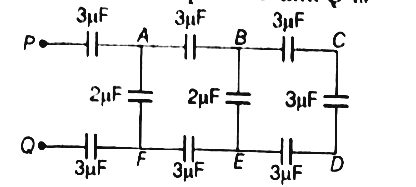 COMEDK 2022 Easy
 - The correct order of increasing melting point isCOMEDK 2024 Medium
- If \(\tan x^{\circ} \tan 2^{\circ} \tan 3^{\circ} \ldots \ldots \ldots \ldots . \tan 88^{\circ} \tan y^{\circ}=1\) then \(\cot (x+y)=\)COMEDK 2025 Medium