


COMEDK · Chemistry · 25. Haloalkanes and Haloarenes
Both reactions (i) and (ii) give the same compound X as the major product. Identify X
(i). 3-Methylbut-1-ene \(+\mathrm{HCl} \rightarrow \mathrm{X}\)
(ii). Neopentyl alcohol \(+\mathrm{HCl}\left(\right.\) anh. \(\left.\mathrm{ZnCl}_2\right) \rightarrow \mathrm{X}\)
- A \(\left(\mathrm{CH}_3\right)_2-\mathrm{CCl}_{-}-\mathrm{CH}_2-\mathrm{CH}_3\)
- B \(\left(\mathrm{CH}_3\right)_2-\mathrm{CH}-\mathrm{CH}_2-\mathrm{CH}_2 \mathrm{Cl}\)
- C \(\left(\mathrm{CH}_3\right)_2-\mathrm{CH}-\mathrm{CHCl}-\mathrm{CH}_3\)
- D \(\mathrm{CH}_3-\mathrm{CH}_2-\mathrm{CH}\left(\mathrm{CH}_3\right)-\mathrm{CH}_2 \mathrm{Cl}\)
Answer & Solution
Correct Answer
(A) \(\left(\mathrm{CH}_3\right)_2-\mathrm{CCl}_{-}-\mathrm{CH}_2-\mathrm{CH}_3\)
Step-by-step Solution
Detailed explanation
In reaction (i), the electrophilic addition of \(\mathrm{HCl}\) to 3-methylbut-1-ene proceeds via the formation of a carbocation. The initial protonation of the double bond yields the secondary carbocation \((CH_3)_2CH-CH^{+}-CH_3\). This secondary carbocation undergoes a…
See the Complete Solution
Get step-by-step explanations for this and 2.5 Lakh+ more JEE, NEET & CET questions.
- Unlock all solutions
- Practice the full chapter
- Track accuracy across PYQs
4.8 rated on Google Play · 14,000+ reviews
More questions from Chemistry
- In acetylene molecule, the two carbon atoms are linked byCOMEDK 2016 Easy
- A transition elements with atomic number 24 will have its magnetic momentCOMEDK 2015 Easy
- For a reaction \(\mathrm{X}_2(\mathrm{l})+\mathrm{Y}_2(\mathrm{~g}) \leftrightharpoons 2 \mathrm{XY}(\mathrm{g})\), the \(\Delta \mathrm{H}^0\) and \(\Delta \mathrm{S}^0\) are \(+29.3 \mathrm{~kJ} / \mathrm{mol}\) and \(104.1 \mathrm{~J} \mathrm{~K}^{-1} \mathrm{~mol}^{-1}\) respectively at 298 K . Find the free energy change in \(\mathrm{kJ} / \mathrm{mol}\).COMEDK 2025 Medium
- Pick out the correct option
Assertion(A): Mercury is not considered as a transition element
Reason (R): Mercury is a liquidCOMEDK 2026 Medium - Which one of the following is the product \((Z)\) formed at the end of the given reaction:
\(\begin{aligned}
& \text { Propan-1-ol }+\mathrm{SOCl}_2 \rightarrow[\mathrm{X}] \\
& {[\mathrm{X}]+\mathrm{HC} \equiv \mathrm{C}-\mathrm{Na} \rightarrow[\mathrm{Y}]} \\
& {[\mathrm{Y}]+\mathrm{H}_2 \mathrm{SO}_4 / \mathrm{HgSO}_4, 330 \mathrm{~K} \rightarrow[\mathrm{Z}]}
\end{aligned}\)COMEDK 2025 Medium - A polysaccharide \([\mathrm{X}]\) represented as \(\left(\mathrm{C}_6 \mathrm{H}_{10} \mathrm{O}_5\right)\) n serves as a reserve carbohydrate in human beings. An enzyme Phosphorylase breaks it down to glucose when required. It is also found in yeast and fungi. What is \([\mathrm{X}]\) ?COMEDK 2025 Easy
More PYQs from COMEDK
- When water falls from a height of \(80 \mathrm{~m}\) at the rate of \(20 \mathrm{~kg} \mathrm{~s}^{-1}\) to operate a turbine the losses due to frictional force are \(20 \%\) of input energy. How much power is generated by the turbine?COMEDK 2024 Medium
- The number of structural isomers possible for a compound with molecular formula \(\text{C}_3\text{H}_9\text{N}\) is:COMEDK 2026 Medium
- If \(\vec{a}, \vec{b}, \vec{c}\) are three vectors such that \(a \neq 0\), \(|\vec{a}| = |\vec{c}| = 1, |\vec{b}| = 4\) and \(|\vec{b} \times \vec{c}| = \sqrt{15}\). If \(\vec{b} - 2\vec{c} = \lambda\vec{a}\) then \(\lambda^2\) equals:COMEDK 2025 Medium
- Which of the following is not aromatic?
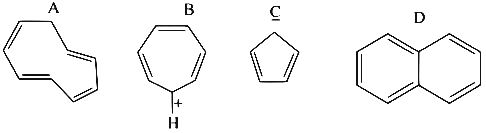 COMEDK 2024 Easy
 - If \({ }^n C_3=220\), then \(n=\) ?COMEDK 2022 Easy
- In the synthesis of NH\(_3\) from H\(_2\) and N\(_2\), if \(6 \times 10^{-2}\) mole of hydrogen disappears in 10 minutes, the number of moles of NH\(_3\) formed in 0.3 minutes is:COMEDK 2026 Medium