


COMEDK · Chemistry · 1. Some Basic Concepts of Chemistry
\(20 \mathrm{~mL}\) of acetic acid reacts with \(20 \mathrm{~mL}\) of ethyl alcohol to form ethyl acetate. The density of acid and alcohol are \(1 \mathrm{~g} / \mathrm{mL}\) and \(0.7 \mathrm{~g} / \mathrm{mL}\) respectively. The limiting reagent in this reaction is
- A acetic acid
- B ethyl alcohol
- C acetic acid and ethyl alcohol
- D ester
Answer & Solution
Correct Answer
(B) ethyl alcohol
Step-by-step Solution
Detailed explanation
Mass of \(20 \mathrm{~mL}\) of acetic acid \(=20 \times 1=20 \mathrm{~g}\) Mass of \(20 \mathrm{~mL}\) of ethyl alcohol \(=20 \times 0.7=14 \mathrm{~g}\) For the reaction,…
See the Complete Solution
Get step-by-step explanations for this and 2.5 Lakh+ more JEE, NEET & CET questions.
- Unlock all solutions
- Practice the full chapter
- Track accuracy across PYQs
4.8 rated on Google Play · 14,000+ reviews
More questions from Chemistry
- Which of the following species do not show disproportionation reaction?COMEDK 2014 Easy
- The system that forms minimum boiling azeotrope is :COMEDK 2024 Medium
- Which one of the following is incorrect?COMEDK 2025 Easy
- In benzene, each carbon atom undergoesCOMEDK 2019 Easy
- What would be the cell potential for the Galvanic cell which is represented by the electrochemical reaction:
\(\begin{aligned}
& 2 \mathrm{Cr}_{(\mathrm{S})}+3 \mathrm{Fe}^{2+}(0.02 \mathrm{M}) \rightarrow 2 \mathrm{Cr}^{3+}(0.2 \mathrm{M})+3 \mathrm{Fe} \\
& \mathrm{E}^0 \mathrm{Fe}^{2+} / \mathrm{Fe}=-0.42 \mathrm{~V} \quad \mathrm{E}^0 \mathrm{Cr}^{3+} / \mathrm{Cr}=-0.72 \mathrm{~V}
\end{aligned}\)COMEDK 2025 Medium - Minimum mumber of nodes are present inCOMEDK 2022 Medium
More PYQs from COMEDK
- Peptisation is a process in whichCOMEDK 2012 Medium
- Which one of the following will undergo Nucleophilic substitution, by \(\mathrm{S}_{\mathrm{N}}{ }^1\) mechanism, fastest?COMEDK 2023 Medium
- In the series \(L-C-R\) circuit shown, the impedance is
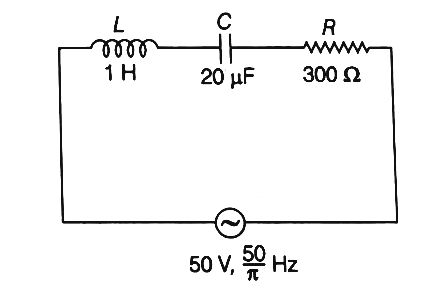 COMEDK 2023 Easy
 - An open hemispherical storage tank has radius 13 m. Oil flows into the tank such that the depth '\(h\)' of oil in the tank changes at the rate of 3 m / hr. When the depth \(h = 1\)m, the rate of change of the area of the top surface of the oil isCOMEDK 2026 Medium
- If the vectors \(\mathbf{a}=2 \hat{\mathbf{i}}-3 \hat{\mathbf{j}}+4 \hat{\mathbf{k}}, \mathbf{b}=\hat{\mathbf{i}}+2 \hat{\mathbf{j}}-\hat{\mathbf{k}}\) and \(\mathbf{c}=m \hat{\mathbf{i}}-\hat{\mathbf{j}}+2 \hat{\mathbf{k}}\) are coplanar, then the value of \(m\) isCOMEDK 2023 Medium
- The motion of a particle of mass \(m\) is described by \(y=u t+g t^{2}\). The force acting on the particle will beCOMEDK 2021 Medium