


AP EAMCET · PHYSICS · Mechanical Properties of Solids
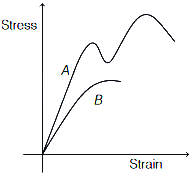
The diagram shows stress versus strain curve for the materials \(A\) and \(B\). From the curves, we can infer that
- A \(A\) is brittle but \(B\) is ductile
- B \(A\) is ductile but \(B\) is brittle
- C Both \(A\) and \(B\) are ductile
- D Both \(A\) and \(B\) are brittle
Answer & Solution
Correct Answer
(B) \(A\) is ductile but \(B\) is brittle
Step-by-step Solution
Detailed explanation
According to stress-strain curve, we see that for same value of applied stress, strain produced is more in material \(B\) than in material \(A\) in linear region. Therefore, \(A\) is ductile but \(B\) is brittle. In ductile materials, yield point exists whereas in brittle…
See the Complete Solution
Get step-by-step explanations for this and 2.5 Lakh+ more JEE, NEET & CET questions.
- Unlock all solutions
- Practice the full chapter
- Track accuracy across PYQs
4.8 rated on Google Play · 14,000+ reviews
More questions from PHYSICS
- When an object is moved along the principle axis of a concave mirror placed in air, the image coincides with the object if the object is \(50 \mathrm{~cm}\) from the mirror. If the mirror is placed at a depth of \(20 \mathrm{~cm}\) in a transparent medium, the image coincides with the object when the object is \(40 \mathrm{~cm}\) from the mirror. The refractive index of the liquid isAP EAMCET 2019 Hard
- Water flowing through a pipe of area of cross-section \(2 \times 10^{-3} \mathrm{~m}^2\) hits a vertical wall horizontally with a velocity of \(12 \mathrm{~m} \mathrm{~s}^{-1}\). If the water does not rebound after hitting the wall, then the force acting on the wall due to water isAP EAMCET 2025 Medium
- An air bubble of radius \(1 \mathrm{~cm}\) rises from the bottom portion through a liquid of density \(1.5 \mathrm{~g} / \mathrm{cc}\) at a constant speed of \(0.25 \mathrm{~cm} \mathrm{~s}^{-1}\). If the density of air is neglected, the coefficient of viscosity of the liquid is approximately, (In Pas) :AP EAMCET 2006 Medium
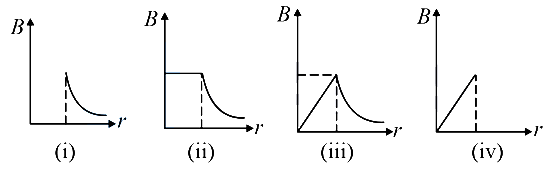
- A long thin hollow metallic cylinder of radius has a current ampere. The magnetic induction away from the axis at a distance from the axis varies as shown in
 AP EAMCET 2021 Medium
 - A short bar magnet of magnetic moment \(0.21 \mathrm{~A}-\mathrm{m}^2\) is placed with its axis perpendicular to the direction of the horizontal component of the earth's magnetic field. The distance of the point on the axis of the magnet from the centre of the magnet where the resultant magnetic field is inclined at \(45^{\circ}\) with the horizontal component of the earth's field direction is (horizontal component of the earth's magnetic field \(=4.2 \times 10^{-5} \mathrm{~T}\) )AP EAMCET 2018 Hard
- Among the following, the equation representing a progressive wave is
(A) \(y=2 \cos 3 x \sin 10 t\)
(B) \(\mathrm{y}=2 \sqrt{\mathrm{x}-\mathrm{vt}}\)
(C) \(y=3 \sin (5 x-0.5 t)+4 \cos (5 x-0.5 t)\)
(D) \(y=\cos x \sin t+\cos 2 x \cdot \sin 2 t\)AP EAMCET 2022 Medium
More PYQs from AP EAMCET
- The most acidic carboxylic acid isAP EAMCET 2025 Medium
- A gody is projected from the ground at an angle of \(\tan ^{-1}\left(\frac{8}{7}\right)\) with the horizontal. The ratio of the maximum height attained by it to its range isAP EAMCET 2018 Easy
- Let \(S(1,0)\) and \(S^{\prime}(0,1)\) be the foci of an eflipse such that \(\mathrm{SP}+\mathrm{S}^{\prime} \mathrm{P}=2\) for any point \(\mathrm{P}\) on the ellipse. If \(\mathrm{A}\left(\mathrm{x}_1, \mathrm{y}_1\right)\) and \(A^{\prime}\left(x_2, y_2\right)\) are the end points of the major axis of this ellipse, then \(x_1+x_2=\)AP EAMCET 2023 Medium
- As ideal monoatomic gas of 1.5 moles is heated at a constant pressure \(2 \mathrm{~atm}\) so that its temperature increases from \(30^{\circ} \mathrm{C}\) to \(130^{\circ} \mathrm{C}\) work done by the gas is (Universal gas constant \(\left.=8.3 \mathrm{~J} \mathrm{~mol}^{-1} \mathrm{~K}^{-1}\right)\)AP EAMCET 2022 Easy
- If the volume of the parallelopiped formed by the vectors and becomes minimum, thenAP EAMCET 2021 Medium
- The triad \((x, y, z)\) of real number such that \((3 \hat{\mathbf{i}}-\hat{\mathbf{j}}+2 \hat{\mathbf{k}})=(2 \hat{\mathbf{i}}+3 \hat{\mathbf{j}}-\hat{\mathbf{k}}) x+\) \(\quad(\hat{\mathbf{i}}-2 \hat{\mathbf{j}}+2 \hat{\mathbf{k}}) y+(-2 \hat{\mathbf{i}}+\hat{\mathbf{j}}-2 \hat{\mathbf{k}}) z\) isAP EAMCET 2017 Easy