


AP EAMCET · PHYSICS · Mathematics in Physics
A vector \(\mathbf{P}\) directed along the \(X\)-axis is added to vector \(\mathbf{Q}\) which has a magnitude of \(10 \mathrm{~m}\). The resultant vector is directed along the \(Y\)-axis, with a magnitude that is 2 times that of \(\mathbf{P}\). The magnitude of \(\mathbf{P}\) is
- A \(\sqrt{10} \mathrm{~m}\)
- B \(5 \sqrt{2} \mathrm{~m}\)
- C \(6 \mathrm{~m}\)
- D \(2 \sqrt{5} \mathrm{~m}\)
Answer & Solution
Correct Answer
(D) \(2 \sqrt{5} \mathrm{~m}\)
Step-by-step Solution
Detailed explanation
By parallelogram law of vector addition, angle made by resultant with \(\mathbf{P}\) is given by; \(\tan \alpha=\frac{Q \sin \theta}{P+Q \cos \theta}\) Here \(\alpha=90^{\circ}\) so ; \(\tan 90^{\circ}=\infty=\frac{Q \sin \theta}{P+Q \cos \theta}\)…
See the Complete Solution
Get step-by-step explanations for this and 2.5 Lakh+ more JEE, NEET & CET questions.
- Unlock all solutions
- Practice the full chapter
- Track accuracy across PYQs
4.8 rated on Google Play · 14,000+ reviews
More questions from PHYSICS
- The internal energy of an ideal gas is given by \(\mathrm{U}=1.5 \mathrm{PV}\). It expands from \(10 \mathrm{~cm}^3\) to \(20 \mathrm{~cm}^3\) against a constant pressure of \(2 \times 10^5 \mathrm{~Pa}\). Heat absorbed by the gas in the process isAP EAMCET 2017 Easy
- When the ideal gas is compressed isothermally, then its pressureAP EAMCET 2021 Easy
- 3 moles of an ideal monoatomic gas performs \(A B C D A\) cyclic process as shown in figure below. The gas temperatures are \(T_A=400 \mathrm{~K}\), \(T_B=800 \mathrm{~K}, T_C=2400 \mathrm{~K}\) and \(T_D=1200 \mathrm{~K}\). The work done by the gas is (approximately) \((R=8.314 \mathrm{~J} / \mathrm{mol} \mathrm{K})\)
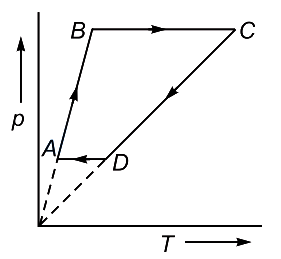 AP EAMCET 2010 Hard
 - When 100 J of heat is supplied to a gas, the increase in the internal energy of the gas is 60 J . Then the gas is/canAP EAMCET 2024 Easy
- If the time period of revolution of a satellite is \(T\). then its kinetic energy is proportional toAP EAMCET 2024 Medium
- A wire of length carrying a current is bent in the form of a circle. Magnitude of its magnetic moment isAP EAMCET 2021 Easy
More PYQs from AP EAMCET
- The order of basic strength of the following in aqueous solution is
I. \(\mathrm{C}_6 \mathrm{H}_5 \mathrm{NH}_2\)
II. \(\left(\mathrm{CH}_3\right)_3 \mathrm{~N}\)
III. \(\mathrm{NH}_3\)
IV. \(\mathrm{CH}_3 \mathrm{NH}_2\)
V. \(\left(\mathrm{CH}_3\right)_2 \mathrm{NH}\)AP EAMCET 2016 Easy - Tom and Jerry play a game of alternately throwing an unfair coin. First one to get head wins. If Tom starts the game, he has chance of winning the game. Suppose this coin is tossed times, then the probability of getting exactly heads isAP EAMCET 2021 Hard
- If the vectors \(\bar{p}, \bar{q}\) and \(\bar{r}\) are such that \((\bar{q} \times \bar{r}) \times(\bar{r} \times \bar{p})=3 \bar{r}\) then \([\bar{p} \times \bar{q} \bar{q} \times \bar{r} \bar{r} \times \bar{p}]=\)AP EAMCET 2017 Medium
- If \(p(x)\) is a polynomial of degree 3 which satisfies \(p^{\prime \prime}(1)=0\) and \(p^{\prime \prime \prime}(1)=6\), then \(p^{\prime \prime}(0)\) is equal toAP EAMCET 2021 Medium
- An inductor of inductance \(\mathrm{L}\), a capacitor of capacitance \(\mathrm{C}\) and a resistor of resistance \(\mathrm{R}\) are connected in series to an ac source. The quality factor of the circuit isAP EAMCET 2023 Easy
- A spherical shell is cut into two pieces along a chord as shown in the figure. \(P\) is a point on the plane of the chord. The gravitational field at \(P\) due to the upper part is \(I_1\) and that due to the lower part is \(I_2\). What is the relation between them?
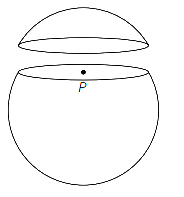 AP EAMCET 2021 Hard