


AP EAMCET · PHYSICS · Thermal Properties of Matter
A glass flask of volume one litre is filled completely with mercury at \(0^{\circ} \mathrm{C}\). The flask is now heated to \(100^{\circ} \mathrm{C}\). Coefficient of volume expansion of mercury is \(1.82 \times 10^{-4} /{ }^{\circ} \mathrm{C}\) and coefficient of linear expansion of glass is \(0.1 \times 10^{-4} /{ }^{\circ} \mathrm{C}\). During this process, amount of mercury which overflows is
- A \(21.2 \mathrm{cc}\)
- B \(15.2 \mathrm{cc}\)
- C \(2.12 \mathrm{cc}\)
- D \(18.2 \mathrm{cc}\)
Answer & Solution
Correct Answer
(B) \(15.2 \mathrm{cc}\)
Step-by-step Solution
Detailed explanation
Due to volume expansion of both mercury and flask, the change in volume of mercury relative to flask is given by \[ \begin{aligned} \Delta V & =V_0\left[\gamma_L-\gamma_g\right] \Delta \theta \\ & =V\left[\gamma_m-3 \alpha_g\right] \Delta \theta \end{aligned} \] Given,…
See the Complete Solution
Get step-by-step explanations for this and 2.5 Lakh+ more JEE, NEET & CET questions.
- Unlock all solutions
- Practice the full chapter
- Track accuracy across PYQs
4.8 rated on Google Play · 14,000+ reviews
More questions from PHYSICS
- A Fraunhofer diffraction pattern due to a narrow slit is obtained on a screen placed at a distance \(D\) from the slit whose slit width is \(a\). The distance of first secondary maximum from the central maximum isAP EAMCET 2020 Medium
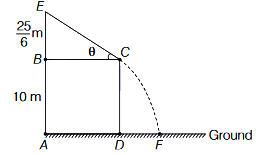
- A rough inclined plane \(B C E\) of height \(\left(\frac{25}{6}\right) \mathrm{m}\) is kept on a rectangular wooden block \(A B C D\) of height \(10 \mathrm{~m}\), as shown in the figure. A small block is allowed to slide down from the top \(E\) of the inclined plane. The coefficient of kinetic friction between the block and the inclined plane is \(\frac{1}{8}\) and the angle of inclination of the inclined plane is \(\sin ^{-1}(0.6)\). If the small block finally reaches the ground at a point \(F\), then \(D F\) will be (Acceleration due to gravity, \(g=10 \mathrm{~ms}^{-2}\))
 AP EAMCET 2019 Hard
 - In amplitude modulation, if a message signal of 5 kHz is modulated by a carrier wave of frequency 900 kHz, then the frequencies of the side bands areAP EAMCET 2025 Easy
- The apparent weight of a girl of mass 30 kg when she is in a lift moving vertically upwards with an acceleration of \(2 \mathrm{~ms}^{-2}\) is (Acceleration due to gravity \(=10 \mathrm{~m} \mathrm{~s}^{-2}\) )AP EAMCET 2025 Easy
- At the moment \(\mathrm{t}=0\), a time dependent force \(\mathrm{F}=\) at (where a is constant equal to \(1 \mathrm{Ns}^{-1}\) ) is applied to a body of mass \(1 \mathrm{~kg}\) resting on a smooth horizontal plane as shown in the figure. If the direction of this force makes an angle \(45^{\circ}\) with the horizontal, then the velocity of the body at the moment it leaves the plane is
(acceleration due to gravity \(=10 \mathrm{~m} \mathrm{~s}^{-2}\) )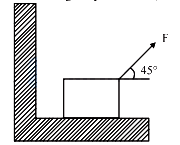 AP EAMCET 2022 Easy
 - A travelling micros dot marked on a pi slab \((\mu=1.5)\) of thic the ink dot. The tra be moved in focus.AP EAMCET 2020 Hard
More PYQs from AP EAMCET
- If are unit vectors and the maximum value of is thenAP EAMCET 2018 Medium
- Let \(a, b\) and \(c\) be positive real numbers. If \(\frac{x^2-b x}{a x-c}=\frac{m-1}{m+1}\) has two roots which are numerically equal but opposite in sign, then the value of \(m\) isAP EAMCET 2021 Easy
- If the coefficients of \(r^{\text {th }},(r+1)^{\text {th }}\) and \((r+2)^{\text {th }}\) terms in the expansion of \((1+x) n\) are in the ratio of \(4: 15: 42\), then \(n-r=\)AP EAMCET 2024 Easy
- A stone of mass \(2 \mathrm{~kg}\) is tied at one end of a string of length \(2 \mathrm{~m}\) and is whirled in a horizontal circle. If the string can withstand a maximum tension of \(64 \mathrm{~N}\), then the permissible maximum number of rotations per minute isAP EAMCET 2023 Medium
- The points at which the function \(f(x)=|x-0.5|+|x-1|+\tan x\) does not have a derivative in the interval \((0,2)\) isAP EAMCET 2017 Medium
- If \(R=\frac{65}{8}, r_1=\frac{21}{2}\) and \(r_2=12\) are the circum radius, radii of the excircles opposite to the vertices \(A\) and \(B\) of a triangle \(A B C\) respectively, then the area of the triangle (in square units) isAP EAMCET 2017 Hard