


AP EAMCET · Maths · Indefinite Integration
\(\int x \operatorname{Cos}^{-1}\left(\frac{1-x^2}{1+x^2}\right) d x(x>0)=\)
- A \(-x+\left(1+x^2\right) \operatorname{Tan}^{-1} x+c\)
- B \(x-\left(1+x^2\right) \operatorname{Cot}^{-1} x+c\)
- C \(-x+\left(1+x^2\right) \operatorname{Cot}^{-1} x+c\)
- D \(x-\left(1+x^2\right) \operatorname{Tan}^{-1} x+c\)
Answer & Solution
Correct Answer
(A) \(-x+\left(1+x^2\right) \operatorname{Tan}^{-1} x+c\)
Step-by-step Solution
Detailed explanation
Let \(x=\tan\theta\). Then \(\operatorname{Cos}^{-1}\left(\frac{1-x^2}{1+x^2}\right) = \operatorname{Cos}^{-1}(\cos 2\theta) = 2\theta = 2\operatorname{Tan}^{-1}x\). \(\int x (2\operatorname{Tan}^{-1} x) d x = 2 \int x \operatorname{Tan}^{-1} x d x\).…
See the Complete Solution
Get step-by-step explanations for this and 2.5 Lakh+ more JEE, NEET & CET questions.
- Unlock all solutions
- Practice the full chapter
- Track accuracy across PYQs
4.8 rated on Google Play · 14,000+ reviews
More questions from Maths
- If \(\mathbf{a}, \mathbf{b}, \mathbf{c}\) are non-coplanar unit vectors such that \(\mathbf{a} \times(\mathbf{b} \times \mathbf{c})=\frac{\mathbf{b}+\mathbf{c}}{\sqrt{2}}\), then the angle between \(\mathbf{a}\) and \(\mathbf{b}\) isAP EAMCET 2018 Easy
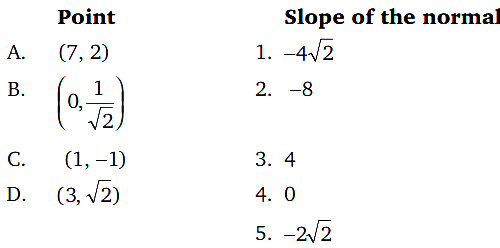
- Match the points on the curve \(2 y^2=x+1\) with the slopes of normals at those points and choose the correct answer.
 AP EAMCET 2004 Hard
 - The modulus of the complex number \(\left(\frac{2+i \sqrt{5}}{2-i \sqrt{5}}\right)^{10}+\left(\frac{2-i \sqrt{5}}{2+i \sqrt{5}}\right)^{10}\) isAP EAMCET 2020 Medium
- If the ratio of the terms equidistant from the middle term in the expansion of \((1+x)^{12}\) is \(\frac{1}{256}(x \in N)\) then sum of all the terms of the expansion \((1+x)^{12}\) isAP EAMCET 2024 Medium
- The solution of the equation \([\sin x+\cos x]^{1+\sin 2 x}=2\), where \(-\pi \leq x \leq \pi\) isAP EAMCET 2021 Medium
- If \(10{ }^n C_2=3^{n+1} C_3\), then the value of \(n\) isAP EAMCET 2022 Easy
More PYQs from AP EAMCET
- Let \(\overrightarrow{\mathbf{a}}, \overrightarrow{\mathbf{b}}, \overrightarrow{\mathbf{c}}\) be the position vectors of the vertices \(A, B, C\) respectively of \(\triangle A B C\). The vector area of \(\triangle A B C\) is :AP EAMCET 2003 Hard
- The general solution of the differential equation \(y y^{\prime}=x\left[\frac{y^2}{x^2}+\frac{\phi\left(\frac{y^2}{x^2}\right)}{\phi^{\prime}\left(\frac{y^2}{x^2}\right)}\right]\), where \(\phi\) is an arbitrary function, isAP EAMCET 2019 Easy
- If in a \(\triangle A B C, r_1 < r_2 < r_3\), then:AP EAMCET 2003 Easy
- If \(x_1, x_2, x_3\) as well as \(y_1, y_2, y_3\) are in geometric progression with the same common ratio, then the points \(\left(x_1, y_1\right)\), \(\left(x_2, y_2\right),\left(x_3, y_3\right)\) areAP EAMCET 2016 Easy
- The group present in prontosil isAP EAMCET 2023 Medium
- If \(\tan \theta \cdot \tan \left(120^{\circ}-\theta\right) \tan \left(120^{\circ}+\theta\right)=\frac{1}{\sqrt{3}}\), then \(\theta\) is equal toAP EAMCET 2015 Easy