


AP EAMCET · Maths · Straight Lines
The equation of the line joining the centroid with the orthocentre of the triangle formed by the points \((-2,3),(2,-1),(4,0)\) is
- A \(x+y-2=0\)
- B \(11 x-y-14=0\)
- C \(x-11 y+6=0\)
- D \(2 x-y-2=0\)
Answer & Solution
Correct Answer
(B) \(11 x-y-14=0\)
Step-by-step Solution
Detailed explanation
Let \(A D\) and \(B E\) are altitudes of the triangle. \(\therefore\) Equation of \(A D\) is given by…
See the Complete Solution
Get step-by-step explanations for this and 2.5 Lakh+ more JEE, NEET & CET questions.
- Unlock all solutions
- Practice the full chapter
- Track accuracy across PYQs
4.8 rated on Google Play · 14,000+ reviews
More questions from Maths
- If \(f(0)=0, f^{\prime}(0)=3\), then the derivative of \(y=f(f(f(f(f(x)))))\) at \(x=0\) isAP EAMCET 2024 Easy
- \(\sin ^3 10^{\circ}+\sin ^3 50^{\circ}-\sin ^3 70^{\circ}=\)AP EAMCET 2025 Medium
- If the \(y\)-intercept of the perpendicular bisector of the line segment joining \(\mathrm{P}(1,4)\) and \(\mathrm{Q}(\mathrm{k}, 3)\) is -4 , then a possible value of \(k\) isAP EAMCET 2023 Medium
- The integral value of \(k\) for which \(x^2-2(4 k-1) x+15 k^2-2 k-7>0\) for all \(x \in \mathbb{R}\) isAP EAMCET 2017 Easy
- Let \(f(x)=x^2+a x+b\), where \(a, b \in R\). If \(f(x)=0\) has all its roots imaginary, then the roots of \(f(x)+f^{\prime}(x)+f^{\prime \prime}(x)=0\) areAP EAMCET 2009 Easy
- \(\int \frac{e^x-1}{e^x+1} d x=\)AP EAMCET 2017 Medium
More PYQs from AP EAMCET
- The direction cosines of two lines are connected by the relations \(l+m-n=0\) and \(l m-2 m n+n l=0\). If \(\theta\) is the acute angle between those lines then \(\cos \theta=\)AP EAMCET 2024 Medium
- The angle between the pair of straight lines formed by joining the points of intersection of \(x^2+y^2=4\) and \(y=3 x+c\) to the origin is a right angle. Then \(c^2\) is equal toAP EAMCET 2007 Hard
- A \(1.0 \mathrm{~L}\) of aqueous solution contains \(1 \times 10^{-8} \mathrm{M} \mathrm{NaBr}, 1 \times 10^{-8} \mathrm{M} \mathrm{NaCl}\) and \(1 \times 10^{-8} \mathrm{M}\) NaI. To this solution, \(1 \times 10^{-10} \mathrm{M}\) aqueous \(\mathrm{AgNO}_3\) solution is added drop wise. The order of precipitation of \(\operatorname{Ag} X(X=\mathrm{Cl}, \mathrm{Br}, \mathrm{I})\) is
\(\begin{aligned} & \left(K_{\mathrm{sp}}(\mathrm{AgCl})=1.8=10^{-10} ; K_{\mathrm{sp}}(\mathrm{AgBr})=5 \times 10^{-13} ;\right. \\ & \left.K_{\mathrm{sp}}(\mathrm{AgI})=8.3 \times 10^{-17}\right)\end{aligned}\)AP EAMCET 2022 Hard - If \(P\) and the origin are the points of intersection of the parabolas \(y^2=32 x\) and \(2 x^2=27 y\); and if \(\theta\) is the acute angle between these curves at \(P\), then \(5 \sqrt{\tan \theta}=\)AP EAMCET 2018 Medium
- A gas in a closed container undergoes the cycle \(\mathrm{ABCA}\) as shown in the figure. The net heat released by the gas after it has undergone 20 cycles is
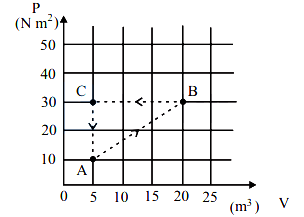 AP EAMCET 2022 Hard
 - Acid hydrolysis of \(X\) yields two different organic compounds. Which one of the following is \(X\) ?AP EAMCET 2003 Easy