


AP EAMCET · Maths · Differential Equations
The differential equation of the family of parabolas with vertex at \((0,-1)\) and having axis along the \(Y\)-axis is
- A \(y y^{\prime}+2 x y+1=0\)
- B \(x y^{\prime}+y+1=0\)
- C \(x y^{\prime}-2 y-2=0\)
- D \(x y^{\prime}-y-1=0\)
Answer & Solution
Correct Answer
(C) \(x y^{\prime}-2 y-2=0\)
Step-by-step Solution
Detailed explanation
Equation of family of parabola having vertex \((0,-1)\) and axis along \(y\)-axis is \[ x^2=4 a(y+1) \] On differentiating both sides w.r.t. \(x\), we get \[ 2 x=4 a y^{\prime} \Rightarrow a=\frac{x}{2 y^{\prime}} \] On putting \(a=\frac{1}{2 y^{\prime}}\) in Eq. (i), we get…
See the Complete Solution
Get step-by-step explanations for this and 2.5 Lakh+ more JEE, NEET & CET questions.
- Unlock all solutions
- Practice the full chapter
- Track accuracy across PYQs
4.8 rated on Google Play · 14,000+ reviews
More questions from Maths
- If \(\mathrm{A}(0,1,2), \mathrm{B}(2,-1,3)\) and \(\mathrm{C}(1,-3,1)\) are the vertices of a triangle, then the distance between its circumcentre and orthocentre isAP EAMCET 2025 Hard
- \(\lim _{x \rightarrow 0} \frac{x^2 \sin ^2(3 x)+\sin ^4(6 x)}{(1-\cos 3 x)^2}=\)AP EAMCET 2025 Medium
- For three vectors \(\mathbf{p}, \mathbf{q}\) and \(\mathbf{r}\), if \(\mathbf{r}=3 \mathbf{p}+4 \mathbf{q}\) and \(2 \mathbf{r}=\mathbf{p}-3 \mathbf{q}\), thenAP EAMCET 2016 Easy
- If \(-\frac{2}{3} < x < \frac{2}{3}\), then the value of the \(5^{\text {th }}\) term in the expansion of \(\frac{1}{\sqrt[3]{2-3 x}}\) when \(x=\frac{1}{2}\) isAP EAMCET 2025 Medium
- \((\sqrt{3}+i)^7+(\sqrt{3}-i)^7\) is equal toAP EAMCET 2010 Hard
- \(\cos ^2\left(\frac{7 \pi}{8}\right)+\cos ^2\left(\frac{5 \pi}{8}\right)+\cos ^2\left(\frac{3 \pi}{8}\right)+\cos ^2\left(\frac{\pi}{8}\right)=\)AP EAMCET 2020 Medium
More PYQs from AP EAMCET
- If \(\tan A\) and \(\tan B\) are the roots of the quadratic equation \(x^2-p x+q=0\), then \(\sin ^2(A+B)\) is equal toAP EAMCET 2011 Medium
- If the plane \(3 x-2 y-z-18=0\) meets the coordinate axes in \(A, B, C\) then the centroid of \(\triangle A B C\) isAP EAMCET 2004 Medium
- If a real valued function \(f(x)=\left\{\begin{array}{cc}(1+\sin x)^{\operatorname{cosec} x}, & -\pi / 2 < x < 0 \\ a, & x=0 \\ \frac{e^{2 / x}+e^{3 / x}}{a e^{2 / x}+b e^{3 / x}}, & 0 < x < \pi / 2\end{array}\right.\), is continuous at \(\mathrm{x}=0\), then \(\mathrm{ab}=\)AP EAMCET 2025 Medium
- A part of a circuit is shown in the figure. The ratio of the potential differences between the points A and C, and the points D and E is
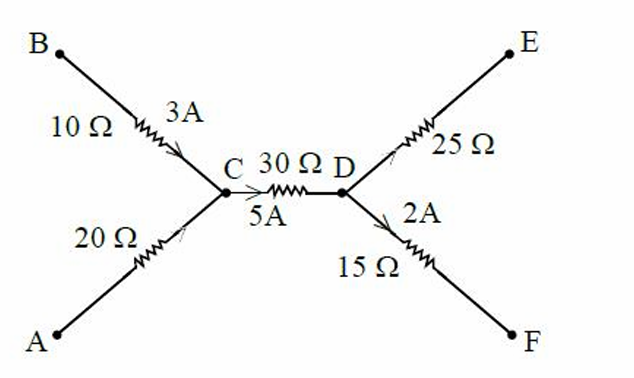 AP EAMCET 2025 Medium
 - The domain of the real valued function
\(f(x)=\sqrt{\frac{2-|x|}{3-|x|}}\) isAP EAMCET 2022 Medium - If \(f(x)=3 x+\frac{12}{x}\) is continuous on \(\mathbb{R}-\{0\}\) and \(M\) is its maximum value, then \(\lim _{x \rightarrow M}(f x)=\)AP EAMCET 2023 Easy