


AP EAMCET · Maths · Continuity and Differentiability
Let \(f(x)\) be a real valued function. If \(f^{\prime}(x)\) is a constant for all \(x \in \mathbb{R}, f(0)=2\) and \(f^{\prime}(0)=1\), then
- A \(\mathrm{f}(\mathrm{x})\) is not continuous on \(\mathbb{R}\)
- B \(f(x)\) is continuous at \(x=0,1,2\) and 3 only
- C \(f(x)\) is continuous only on \([0, \infty)\)
- D \(\mathrm{f}(\mathrm{x})\) is continuous on \(\mathbb{R}\)
Answer & Solution
Correct Answer
(D) \(\mathrm{f}(\mathrm{x})\) is continuous on \(\mathbb{R}\)
Step-by-step Solution
Detailed explanation
Since \(f^{\prime}(x)\) is a constant \[ \therefore f^{\prime}(x)=a \text { (say) }...(1) \] \(\Rightarrow f(x)=a x+b\) where \(b\) is arbitrary constant. ...(2) Since \(f(0)=2 \Rightarrow b=2\) Since \(f^{\prime}(0)=1 \Rightarrow a=1\) \[ \therefore f(x)=(x+2) \] Which is…
See the Complete Solution
Get step-by-step explanations for this and 2.5 Lakh+ more JEE, NEET & CET questions.
- Unlock all solutions
- Practice the full chapter
- Track accuracy across PYQs
4.8 rated on Google Play · 14,000+ reviews
More questions from Maths
- If the circles \(x^2+y^2-2 \lambda x-2 y-7=0\) and \(3\left(x^2+y^2\right)-8 x+29 y=0\) are orthogonal, then \(\lambda=\)AP EAMCET 2025 Medium
- Let the point represent the Argand plane. Let the curves and be the loci of satisfying the conditions is purely imaginary and , respectively. Then the point of intersection of the curves and other than the origin, isAP EAMCET 2019 Medium
- The ratio of the areas of the concentric circles \(x^2+y^2-\) \(6 x+12 y+15=0\) and \(x^2+y^2-6 x+12 y-15=0\) isAP EAMCET 2022 Easy
- Given that \(a, b\) and \(c\) are real numbers such that \(b^2=4 a c\) and \(a>\gamma_0\). The maximal possible set \(D \subseteq R\) on which the function \(f: D \rightarrow R\) given by \(f(x)=\log \left\{a x^3+(a+b) x^2+(b+c) x+c\right\}\) is defined, isAP EAMCET 2018 Medium
- In \(\triangle \mathrm{ABC}\) if \(a=2 b\) and \(|\mathrm{A}-\mathrm{B}|=\frac{\pi}{3}\), then \(\angle \mathrm{C}=\)AP EAMCET 2017 Hard
- Let \(\bar{a}=2 \bar{i}+\bar{j}-\bar{k}\) and \(\bar{b}=\bar{i}+3 \bar{k}\).
If \(\bar{c}\) is a unit vector, then the maximum value of \(\left[\begin{array}{lll}\bar{a} & \bar{b} & \bar{c}\end{array}\right]\) isAP EAMCET 2017 Easy
More PYQs from AP EAMCET
- The time constant of inductance coil is \(3 \mathrm{~m} \mathrm{~s}\). When a \(90 \Omega\) resistance is joined in series, then the time constant becomes \(0.5 \mathrm{~m} \mathrm{~s}\). The inductance and the resistance of the coil areAP EAMCET 2010 Hard
- If two numbers \(a\) and \(b\) are chosen from the set of integers 1 to 39 , then the probability that those numbers satisfy the equation \(7 a-9 b=0\) isAP EAMCET 2018 Easy
- Two blocks and of masses and are as shown in the figure. A horizontal force of is required to make slip over . Find the maximum horizontal force that can be applied on so that both and move together. (take )
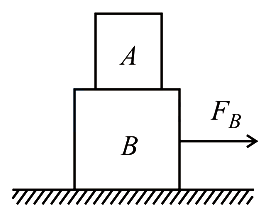 AP EAMCET 2021 Hard
 - If \(\int \frac{\sin ^8 x-\cos ^8 x}{1-2 \sin ^2 x \cos ^2 x} d x=A \sin 2 x+B\), then \(A\) is equal toAP EAMCET 2011 Medium
- The surface of a metal is first illuminated with a light of wavelength 300 nm and later illuminated by another light of wavelength 500 nm . It is observed that the ratio of maximum velocities of photo electrons in two cases is 3. The work function of metal value is close toAP EAMCET 2024 Hard
- The area (in square units) bounded by the curves \(y=2 x^2\) and \(y=\max \{x-[x], x+|x|\}\) in between the lines \(x=0\) and \(x=2\) isAP EAMCET 2018 Easy