


AP EAMCET · Maths · Complex Number
If \(\mathrm{P}(x, y)\) represents the complex number \(z=x+i y\) in the Argand plane and \(\operatorname{Arg}\left(\frac{z-3 i}{z+4}\right)=\frac{\pi}{2}\), then the equation of the locus of P is
- A \(x^2+y^2+4 x-3 y=0\) and \(3 x-4 y\gt0\)
- B \(x^2+y^2+4 x-3 y+2=0\) and \(3 x-4 y\gt0\)
- C \(x^2+y^2+4 x-3 y=0\) and \(3 x-4 y \lt 0\)
- D \(x^2+y^2+4 x-3 y+2=0\) and \(3 x-4 y \lt 0\)
Answer & Solution
Correct Answer
(C) \(x^2+y^2+4 x-3 y=0\) and \(3 x-4 y \lt 0\)
Step-by-step Solution
Detailed explanation
\begin{aligned} & \frac{z-3 i}{z+4}=\frac{x+(y-3) i}{(x+4)+y i} \times \frac{(x+4)-y i}{(x+4)-y i} \\ &= \frac{x(x+4)-x y i+(x+4)(y-3) i+y(y-3)}{(x+4)^2+y^2} \\ &= \frac{x^2+y^2+4 x-3 y+(4 x-3 x) i}{(x+4)^2+y^2} \\ & \operatorname{Arg}\left(\frac{z-3 i}{z+4}\right)=\frac{\pi}{2}…
See the Complete Solution
Get step-by-step explanations for this and 2.5 Lakh+ more JEE, NEET & CET questions.
- Unlock all solutions
- Practice the full chapter
- Track accuracy across PYQs
4.8 rated on Google Play · 14,000+ reviews
More questions from Maths
- If the roots of the equation \(3 x^2+4 k x+3=0\) are non-real, then \(\mathrm{k}\) lies in the intervalAP EAMCET 2023 Easy
- \(\int \frac{\sin ^3(x)+\cos ^3(x)}{\sin ^2(x) \cdot \cos ^2(x)} d x=\)AP EAMCET 2020 Medium
- The coordinates of the point \((3,-7,5)\) in the new system, when the origin is shifted to the point \((-1,-1,-1)\) by the translation coordinate of axes, isAP EAMCET 2023 Easy
- If \(P M\) is the perpendicular from \(P(2,3)\) onto the line \(x+y=3\), then the coordinates of \(M\) areAP EAMCET 2005 Easy
- If \(\int \sqrt{\frac{2}{1+\sin x}} d x=2 \log |A(x)-B(x)|+C\) and \(0 \leq x \leq \frac{\pi}{2}\) then \(B\left(\frac{\pi}{4}\right)=\)AP EAMCET 2024 Hard
- \(\int e^x(x+1)^2 d x=\)AP EAMCET 2024 Easy
More PYQs from AP EAMCET
- The final product \((\mathrm{C})\) in the given reaction sequence is
\(\mathrm{C}_6 \mathrm{H}_5 \mathrm{COOH} \xrightarrow{\mathrm{SOCl}_2}(\mathrm{A}) \xrightarrow[\text { anhy. } \mathrm{AlCl}_3]{\mathrm{C}_6 \mathrm{H}_6}(\mathrm{B}) \xrightarrow[\text { (ii) } \mathrm{KOH} /\left(\mathrm{CH}_2 \mathrm{OH}\right)_2]{\text { (i) } \mathrm{NH}_2-\mathrm{NH}_2}(\mathrm{C})\)AP EAMCET 2025 Medium - The charge on \(4 \mu \mathrm{F}\) capacitor, in the given circuit is
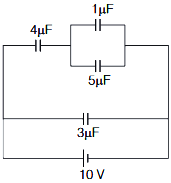 AP EAMCET 2019 Easy
 - The differential equation for which \(y^2=4 a(x+a)\) (a is the parameter) is the general solution isAP EAMCET 2025 Medium
- The van't Hoff factor for 0.5 m aqueous \(\mathrm{CH}_2 \mathrm{FCOOH}\) solution is 1.075. What is the experimentally observed \(\Delta \mathrm{T}_{\mathrm{f}}\) (in K ) for this solution ?
\(\left(\mathrm{K}_{\mathrm{f}}=1.86 \mathrm{~K} \mathrm{~kg} \mathrm{~mol}^{-1}\right)\)AP EAMCET 2025 Medium - The displacement \(y(\) in \(\mathrm{cm})\) in case of a simple harmonic wave is given by \(y=\frac{10}{\pi} \sin \left(2000 \pi t-\frac{\pi x}{17}\right)\). The period and maximum velocity of the particles in the medium will respectively beAP EAMCET 2020 Easy
- A body of mass \(M \mathrm{~kg}\) is on the top point of a smooth hemisphere of radius \(5 \mathrm{~m}\). It is released to slide down the surface of the hemisphere. It leaves the surface when velocity is \(5 \mathrm{~m} / \mathrm{s}\). At this instant the angle made by the radius vector of the body with the vertical is (Acceleration due to gravity \(=10 \mathrm{~ms}^{-2}\) )AP EAMCET 2002 Medium