


AP EAMCET · Maths · Binomial Theorem
If \(n \geq 100\) and the coefficient of \(x^{100}\) in \(1+(1+x)+(1+x)^2+\cdots+(1+x)^n\) is \({ }^{201} C_{101}\), then \(n=\)
- A 100
- B 200
- C 101
- D 190
Answer & Solution
Correct Answer
(B) 200
Step-by-step Solution
Detailed explanation
\(1+(1+x)+\cdots+(1+x)^n = \frac{(1+x)^{n+1}-1}{x}\) Coeff. of \(x^{100}\) in \(\frac{(1+x)^{n+1}-1}{x}\) is coeff. of \(x^{101}\) in \((1+x)^{n+1}-1\). Coeff. of \(x^{101}\) in \((1+x)^{n+1}\) is \({^{n+1}C_{101}}\). \({^{n+1}C_{101}} = {^{201}C_{101}}\) \(n+1 = 201\)…
See the Complete Solution
Get step-by-step explanations for this and 2.5 Lakh+ more JEE, NEET & CET questions.
- Unlock all solutions
- Practice the full chapter
- Track accuracy across PYQs
4.8 rated on Google Play · 14,000+ reviews
More questions from Maths
- \(\mathbf{A B}=\mathbf{a}\) and \(\mathbf{A C}=\mathbf{b}\) are the sides of \(\mathbf{a} \triangle A B C . P\) is a point on \(\mathbf{A B}\) and \(Q\) is a point on \(\mathbf{B C}\) such that \(\frac{A P}{P B}=\frac{1}{2}\) and \(\frac{B Q}{Q C}=\frac{1}{2}\). If the point of intersection of \(\mathbf{A Q}\) and \(\mathbf{C P}\) is \(D\) and the area of \(\triangle B C D\) is 7 square units, then the area of the \(\triangle A B C\) (in the same sq units) isAP EAMCET 2019 Medium
- The variance of the following data is
\[
\begin{array}{cccccccc}
x_i & 6 & 10 & 14 & 18 & 24 & 28 & 30 \\
f_i & 2 & 4 & 7 & 12 & 8 & 4 & 3
\end{array}
\]AP EAMCET 2017 Medium - The remainder when the polynomial \(2 x^5-3 x^4+5 x^3-3 x^2+7 x-9\) is divided by \(x^2-x-3\) isAP EAMCET 2022 Easy
- There are 8 boys and 7 girls in a class room. If the names of all those children are written on paper slips and 3 slips are drawn at random from them, then the probability of getting the names of one boy and two girls or one girl and two boys isAP EAMCET 2025 Medium
- For the parabola \(y^2+6 y-2 x+5=0\), match the items in List-I with the suitable item in List-II given below:
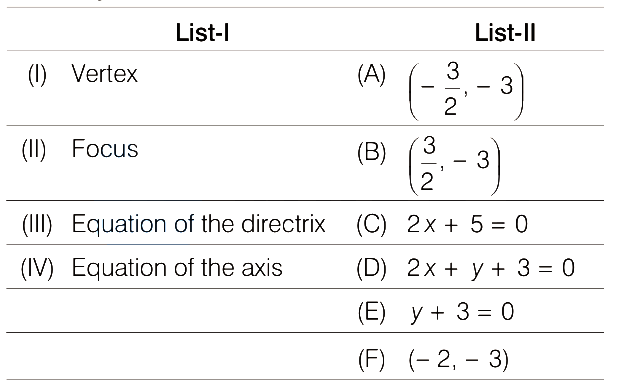
The correct matching is
I \(\quad\) II \(\quad\) III \(\quad\) IVAP EAMCET 2018 Easy - Let \(\bar{a}=4 \bar{i}+5 \bar{j}-\bar{k}, \bar{b}=\bar{i}-4 \bar{j}+5 \bar{k}, \bar{c}=3 \bar{i}+\bar{j}-\bar{k}\) and let \(\bar{\alpha}\) be a vector perpendicular to both \(\bar{a}\) and \(\bar{b}\) such that \(\bar{\alpha} \cdot \bar{c}=63\). Then \(\bar{\alpha}=\)AP EAMCET 2017 Easy
More PYQs from AP EAMCET
- 209 g of an element reacts with chlorine to form 315.5 g of its chloride. What is the weight (in g ) of oxygen that reacts with 418 g of same element?
\((\mathrm{C} \ell=35.5 \mathrm{u} ; \mathrm{O}=16 \mathrm{u})\)AP EAMCET 2025 Medium - A point mass of \(10 \mathrm{~kg}\) is placed at the centre of earth. The weight of the point mass isAP EAMCET 2020 Easy
- In the reaction sequence \(Y\) is
\(\mathrm{CH}_3 \mathrm{CO}_2 \mathrm{H} \xrightarrow[\text { (2) } \Delta]{\text { (1) } \mathrm{NH}_3} \mathrm{P} \xrightarrow{\mathrm{Br}_2 / \mathrm{NaOH}} \mathrm{Y}\)AP EAMCET 2024 Hard - \(\int_0^{\pi / 2} \sin ^m x \cos ^4 x d x=\frac{7 \pi}{2048} \Rightarrow m=\)AP EAMCET 2022 Easy
- Same quantity of electricity was passed through solutions of sales of elements \(X, Y\) and \(Z\) with atomic masses 7,27 and 48 respectively. The mass of \(X, Y\) and \(Z\) deposited were \(2.1 \mathrm{~g}, 2.7 \mathrm{~g}\) and \(7.2 \mathrm{~g}\) respectively. The valence's of \(X, Y\) and \(Z\) respectively areAP EAMCET 2021 Medium
- Electronic configurations of four elements \(\mathrm{A}, \mathrm{B}, \mathrm{C}, \mathrm{D}\) are given below
A) \(1 \mathrm{~s}^2 2 \mathrm{~s}^2 2 \mathrm{p}^6 3 \mathrm{~s}^1\)
B) \(1 s^2 2 s^2 2 p^6 3 s^2 3 p^1\)
C) \(1 s^2 2 s^2 2 p^6 3 s^2\)
D) \(1 s^2 2 s^2 2 p^6 3 s^2 3 p^2\)
The correct order of first ionization enthalpy of these elements isAP EAMCET 2025 Medium