


AP EAMCET · Maths · Functions
If \(\mathrm{f}: \mathbb{R} \rightarrow \mathbb{R}\) is defined by \(\mathrm{f}(\mathrm{x}+\mathrm{y})=\mathrm{f}(\mathrm{x})+\mathrm{f}(\mathrm{y}) \forall \mathrm{x}, \mathrm{y} \in\) \(\mathbb{R}\) and \(f(1)=7\), then \(\sum_{r=1}^n f(r)=\)
- A \(\frac{3 n(n+2)}{4}\)
- B \(\frac{\mathrm{n}(\mathrm{n}-1)}{2}\)
- C \(\frac{7 n(n+1)}{2}\)
- D \(\frac{(\mathrm{n}+1)(\mathrm{n}+2)}{4}\)
Answer & Solution
Correct Answer
(C) \(\frac{7 n(n+1)}{2}\)
Step-by-step Solution
Detailed explanation
Since \(f(x+y)=f(x)+f(y), \forall x, y \in R\) \(\Rightarrow f(x)=a x\) where \(a \in R\) Since given, \(\mathrm{f}(1)=7 \Rightarrow 7=\mathrm{a} \times 1 \Rightarrow \mathrm{a}=7\) \(\Rightarrow \mathrm{f}(\mathrm{x})=7 \mathrm{x}\) Now,…
See the Complete Solution
Get step-by-step explanations for this and 2.5 Lakh+ more JEE, NEET & CET questions.
- Unlock all solutions
- Practice the full chapter
- Track accuracy across PYQs
4.8 rated on Google Play · 14,000+ reviews
More questions from Maths
- If \(\mathrm{P}\) is the set of all real numbers \(\alpha\) such that the product of the lengths of perpendiculars from \((\alpha, 1)\) to the pair of straight lines \(3 x^2+7 x y+2 y^2=0\) is \(\frac{\sqrt{2}}{5}\) then the sum of the elements in \(\mathrm{P}\) isAP EAMCET 2017 Easy
- \(\begin{array}{r}
\left(1+\cos \frac{\pi}{8}\right)\left(1+\cos \frac{2 \pi}{8}\right) \\
\left(1+\cos \frac{3 \pi}{8}\right)\left(1+\cos \frac{4 \pi}{8}\right) \\
\left(1+\cos \frac{5 \pi}{8}\right)\left(1+\cos \frac{6 \pi}{8}\right)\left(1+\cos \frac{7 \pi}{8}\right)=
\end{array}\)AP EAMCET 2018 Medium - If \(\cosh x=\frac{5}{4}\), then \(\tanh 3 x=\)AP EAMCET 2023 Medium
- If \(\alpha \in \mathbb{R}-\{-1\}\) and \(\mathrm{f}(\mathrm{x})=|(|\mathrm{x}|+\alpha)(|\mathrm{x}|-1)|\), then the number of points at which \(f(x)\) is not differentiable, isAP EAMCET 2023 Easy
- If the volume of the parallelopiped formed by the vectors and becomes minimum, thenAP EAMCET 2021 Medium
- If the form of the solution of the differential equation \(\left(y^3+x\right) \frac{d y}{d x}=y\) when \(y(4)=2\) is \(y^3=a x+b\), then \(4 a+12 b^2=\)AP EAMCET 2017 Medium
More PYQs from AP EAMCET
- The sum of the squares of the intercepts made by the line on the co-ordinate axes equalsAP EAMCET 2021 Easy
- \(\lim _{y \rightarrow 0} \frac{\sqrt{1+\sqrt{1+y^4}}-\sqrt{2}}{y^4}=\)AP EAMCET 2025 Medium
- \(\int \frac{1}{9 \cos ^2 x-24 \sin x \cos x+16 \sin ^2 x} d x=\)AP EAMCET 2025 Medium
- Two situations are shown in fig. (a) and (b).
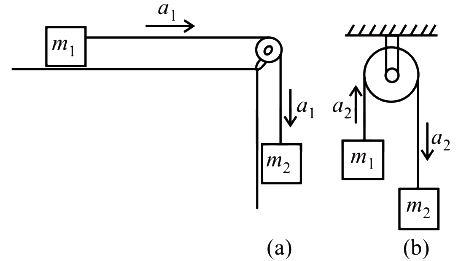
In each case, \(m_1=3 \mathrm{~kg}\) and \(m_2=4 \mathrm{~kg}\). If \(a_1, a_2\) are the respective accelerations of the blocks in these situations, then the values of \(a_1\) and \(a_2\) are respectively [ \(g=10 \mathrm{~ms}^{-2}\) ]AP EAMCET 2017 Easy - The equation \(x^2-2 \sqrt{3} x+2=0\) represents two sides of a triangle. If the angle between them is \(\frac{\pi}{3}\), then the perimeter of that triangle isAP EAMCET 2017 Hard
- The magnetic field at the centre of a long solenoid having 400 turns per unit length and carrying a current ' \(i\) ' is \(6.24 \times 10^{-2} \mathrm{~T}\). The magnetic field at the centre of another long solenoid having 200 turns per unit length and carrying a current \(\frac{' i^{\prime}}{2}\) isAP EAMCET 2025 Medium