


AP EAMCET · Maths · Quadratic Equation
\(\alpha\) and \(\beta\) are the roots of the equation \(x^2-a x+b=0\). If \(\alpha^2+\beta^2\) and \(\alpha^3+\beta^3\) are the roots of the equation \(\mathrm{Ax}^2+\mathrm{Bx}+\mathrm{C}=0\), then \(\mathrm{C}=\)
- A \(a^5-5 a^3 b+6 a b^2\)
- B \(a^5+5 a^3 b-6 a b^2\)
- C \(a^5-5 a^3 b-6 a b^2\)
- D \(a^5+5 a^3 b+6 a b^2\)
Answer & Solution
Correct Answer
(A) \(a^5-5 a^3 b+6 a b^2\)
Step-by-step Solution
Detailed explanation
Since \(\alpha+\beta=a, \alpha \beta=b\) Now \(\alpha^2+\beta^2=(\alpha+\beta)^2-2 \alpha \beta=a^2-2 b\) \(\alpha^3+\beta^3=(\alpha+\beta)\left(\alpha^2+\beta^2-\alpha \beta\right)=a\left(a^2-3 b\right)\) So, quadratic equation…
See the Complete Solution
Get step-by-step explanations for this and 2.5 Lakh+ more JEE, NEET & CET questions.
- Unlock all solutions
- Practice the full chapter
- Track accuracy across PYQs
4.8 rated on Google Play · 14,000+ reviews
More questions from Maths
- \(\int_0^1 x \operatorname{Sin}^{-1} x d x=\)AP EAMCET 2025 Medium
- If the equation of the plane passing through the point and perpendicular to the vector is thenAP EAMCET 2022 Easy
- If \(z=x+i y, x, y \in R\) and the imaginary part of \(\frac{\bar{z}-1}{\bar{z}-i}\) is 1 , then the locus of \(z\) isAP EAMCET 2019 Easy
- If the range of a random variable \(X\) is \(\{0,1,2,3,4, \ldots \ldots\}\) with \(P(X=k)=\frac{(k+1) a}{3^k}\) for \(k \geq 0\), then \(a\) is equal toAP EAMCET 2005 Hard
- Match the following
Quadratic expression The minimum value (i) \(x^2-8 x+15\) (a) \(\quad \frac{7}{2}\) (ii) \(x^2-8 x+17\) (b) \(\quad-1\) (iii) \(2 x^2+4 x+7\) (c) 1 iv) \(\left(x+\frac{5}{3}\right)^2+\frac{7}{2}\) (d) 5 AP EAMCET 2017 Medium - For \(x>2\), then equation \(\sqrt{x+2}-\sqrt{x-2}=\sqrt{4 x-2}\) hasAP EAMCET 2019 Easy
More PYQs from AP EAMCET
- A dc source with internal resistance is connected to three identical resistors each of resistance as shown in the figure. If the thermal power generated in the circuit is highest, then
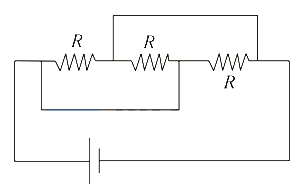 AP EAMCET 2018 Medium
 - The law which states that 'a variation in an electric field causes magnetic field', isAP EAMCET 2021 Easy
- If \(\frac{x^2+5 x+7}{(x-3)^3}+\frac{A}{(x-3)}+\left[\frac{B}{(x-3)^2}+\frac{C}{(x-3)^3}\right.\), then the equation of the line having slope \(A\) and passing through the point \((B, C)\) isAP EAMCET 2018 Easy
- A pair of perpendicular lines passes through the origin and also through the points of intersection of the curve \(x^2+y^2=4\) with \(x+y=a\), where \(a>0\). Then \(a\) is equal toAP EAMCET 2010 Hard
- Which among the following has the highest concentration ofAP EAMCET 2021 Easy
- \(1+\cos ^2 \theta=3 \sin \theta \cos \theta \Rightarrow \theta=\)AP EAMCET 2017 Hard