


AP EAMCET · Maths · Probability
A problem in Algebra is given to two students \(A\) and \(B\) whose chances of solving it are \(\frac{2}{5}\) and \(\frac{3}{4}\) respectively. The probability that the problem is solved if both of them try independently is
- A \(\frac{17}{20}\)
- B \(\frac{3}{20}\)
- C \(\frac{1}{2}\)
- D \(\frac{13}{20}\)
Answer & Solution
Correct Answer
(A) \(\frac{17}{20}\)
Step-by-step Solution
Detailed explanation
\( P(\text{A does not solve}) = 1 - \frac{2}{5} = \frac{3}{5} \) \( P(\text{B does not solve}) = 1 - \frac{3}{4} = \frac{1}{4} \) \( P(\text{problem not solved}) = P(\text{A does not solve}) \times P(\text{B does not solve}) = \frac{3}{5} \times \frac{1}{4} = \frac{3}{20} \)…
See the Complete Solution
Get step-by-step explanations for this and 2.5 Lakh+ more JEE, NEET & CET questions.
- Unlock all solutions
- Practice the full chapter
- Track accuracy across PYQs
4.8 rated on Google Play · 14,000+ reviews
More questions from Maths
- If \(A, B, C\) are the angles of triangle then \(\sin 2 A-\sin 2 B+\) \(\sin 2 C=\)AP EAMCET 2024 Easy
- \(\int_9^x \frac{f(y)}{y^2} d y=2 \sqrt{x}-6 \Rightarrow f(x)=\)AP EAMCET 2022 Medium
- The points \(A(2,-1,4), B(1,0,-1), C(1,2,3)\) and \(D(2,1,8)\) form aAP EAMCET 2019 Easy
- The number of all possible solutions of the equation \(\mathrm{z}^3+\overline{\mathrm{z}}=0\) isAP EAMCET 2023 Hard
- If are non-coplanar vectors, then the point of intersection of the line passing through the points with the line joining the points , isAP EAMCET 2018 Medium
- If the line of intersection of the planes \(2 x+3 y+z=1\) and \(x+3 y+2 z=2\) makes an angle \(\alpha\) with the positive x -axis, then \(\cos \alpha=\)AP EAMCET 2025 Medium
More PYQs from AP EAMCET
- The values of \(x\) for which \(\sin x+i \cos 2 x\) and \(\cos x-i \sin 2 x\) are conjugate to each other areAP EAMCET 2022 Easy
- Assertion (A) The number 0.00764 has three significant figures.
Reason (R) If the number is less than 1 , the zeros on the right of the decimal point but to the left of the first non-zero digit are not significant.AP EAMCET 2019 Easy - \(P Q\) represents a wavefront and \(A O\) and \(B P\), the corresponding two rays. Find the condition on \(Q\) for constructive interference at \(P\) between ray \(B P\) and reflected ray \(O P\).
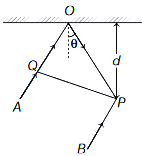 AP EAMCET 2020 Medium
 - Real gases deviate from ideal behaviour because the moleculesAP EAMCET 2020 Medium
- The two enantiomers of secondary butyl chloride differ from each other in which one of the following properties?AP EAMCET 2010 Easy
- The shortest distance between the line \(y-x=1\) and the curve \(x=y^2\) isAP EAMCET 2017 Medium