


AP EAMCET · Chemistry · s Block Elements
Which factor makes Li the strongest reducing agent in aqueous solution?
- A Sublimation enthalpy
- B lonisation enthalpy
- C Hydration enthalpy
- D Electron gain enthalpy
Answer & Solution
Correct Answer
(C) Hydration enthalpy
Step-by-step Solution
Detailed explanation
Lithium has highest hydration enthalpy, which accounts for its high negative \(E^{\circ}\) value and its high reducing power. Hence, the correct option is (c).
See the Complete Solution
Get step-by-step explanations for this and 2.5 Lakh+ more JEE, NEET & CET questions.
- Unlock all solutions
- Practice the full chapter
- Track accuracy across PYQs
4.8 rated on Google Play · 14,000+ reviews
More questions from Chemistry
- Match the following.
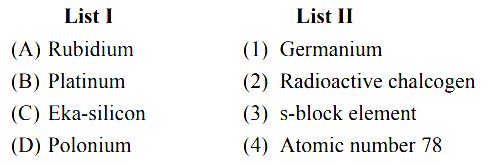 AP EAMCET 2015 Medium
 - A golf ball of mass '\(m\)' has a speed of \(50 \mathrm{~ms}^{-1}\), If the speed can be measured within accuracy of \(2 \%\), the uncertainty in the position isAP EAMCET 2024 Easy
- Match the entries from Column I and Column II and choose the correct order.
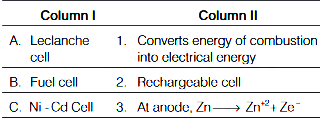 AP EAMCET 2020 Easy
 - Calculate the amount of hydrogen gas required in order to produce \(100 \mathrm{~g}\) of ammonia by the reaction of \(\mathrm{N}_2(g)\) and \(\mathrm{H}_2(g)\) gases.AP EAMCET 2021 Easy
- Arrange the oxides \(\mathrm{CrO}, \mathrm{CrO}_3\) and \(\mathrm{Cr}_2 \mathrm{O}_3\) in the decreasing order of acidic strengthAP EAMCET 2023 Easy
- If the rate of disappearance of \(\mathrm{N}_2 \mathrm{O}_5\) in the following reaction is \(1.2 \times 10^{-5}\) in \(\mathrm{mol} \mathrm{L}^{-1} \mathrm{~s}^{-1}\), the rate of production of \(\mathrm{NO}_2 \mathrm{~mol} \mathrm{~L}^{-1} \mathrm{~s}^{-1}\) is
\(2 \mathrm{~N}_2 \mathrm{O}_5(g) \longrightarrow 4 \mathrm{NO}_2(g)+\mathrm{O}_2(g)\)AP EAMCET 2016 Easy
More PYQs from AP EAMCET
- If the most probable speed of methane at a certain temperature is \(400 \mathrm{~ms}^{-1}\), the kinetic energy of one mole of methane at the same temperature in \(\mathrm{J}\) is మీథేన్ గతిజశక్తి J లలోAP EAMCET 2018 Medium
- If a hyperbola has asymptotes \(3 x-4 y-1=0\) and \(4 x-3 y-6=0\), then the transverse and conjugate axes of that hyperbola areAP EAMCET 2025 Medium
- The equations of motion of a projectile are given by \(x=36 t\) metre and \(2 y=96 t-9.8 t^2\) metre. The angle of projection is :AP EAMCET 2003 Medium
- \(\lim _{x \rightarrow 0} \frac{x \tan 2 x-2 x \tan x}{(1-\cos 3 x)(\operatorname{cosec} x-\cot x)^2}=\)AP EAMCET 2025 Hard
- 209 g of an element reacts with chlorine to form 315.5 g of its chloride. What is the weight (in g ) of oxygen that reacts with 418 g of same element?
\((\mathrm{C} \ell=35.5 \mathrm{u} ; \mathrm{O}=16 \mathrm{u})\)AP EAMCET 2025 Medium - At \(27^{\circ} \mathrm{C}\) in a \(10 \mathrm{~L}\) flask \(4.0 \mathrm{~g}\) of an ideal gaseous mixture containing. He (molar mass \(4.0 \mathrm{~g} \mathrm{~mol}^{-1}\) ) and \(\mathrm{Ne}\) (molar mass \(\left.20 \mathrm{~g} \mathrm{~mol}^{-1}\right)\) has a pres sure of \(1.23 \mathrm{~atm}\). What is the mass \(\%\) of neon ? \(\left(R=0.082 \mathrm{~L} \mathrm{~atm} \mathrm{~K}^{-1} \mathrm{~mol}^{-1}\right)\)AP EAMCET 2017 Medium