


AP EAMCET · Chemistry · Solid State
Which anong the following is a bactericidal antibiotic?
- A Penicillin
- B Erythromycin
- C Tetracycline
- D Chloramphenicol
Answer & Solution
Correct Answer
(A) Penicillin
Step-by-step Solution
Detailed explanation
Ofloxacin, Penicillin, Aminoglycosides are bactericidal antibiotics. They kill bacteria. Tetracycline, Chloramphenicol and Erythromycin are bacteriostatic antibiotics. They inhibit growth of bacteria.
See the Complete Solution
Get step-by-step explanations for this and 2.5 Lakh+ more JEE, NEET & CET questions.
- Unlock all solutions
- Practice the full chapter
- Track accuracy across PYQs
4.8 rated on Google Play · 14,000+ reviews
More questions from Chemistry
- The diameters range of colloidal particles is approximately.AP EAMCET 2022 Easy
- Which of the following is used as froth stabilizer in froth floatation process?AP EAMCET 2025 Easy
- In the following reaction, \(X\) and \(Y\) are respectively
\[
\mathrm{CH}_3 \mathrm{COOH}+\mathrm{NH}_3 \longrightarrow X \stackrel{\Delta}{\longrightarrow} Y+\mathrm{H}_2 \mathrm{O}
\]AP EAMCET 2002 Medium - The value of work function of a metal \(\mathrm{X}\) is \(3.1 \mathrm{eV}\). The threshold frequency of it (in \(\mathrm{Hz})\left(\mathrm{h}=6.62 \times 10^{-34} \mathrm{Js}\right)\)AP EAMCET 2022 Easy
- At \(1000 \mathrm{~K}\), the partial pressures of \(\mathrm{CO}_2(g)\) and \(\mathrm{CO}(g)\) for the reaction \(\mathrm{CO}_2(g)+\mathrm{C}(s) \rightleftharpoons 2 \mathrm{CO}(g)\) in a closed vessel at equilibrium are 0.15 and 0.60 bar respectively. The \(K_c\) for this reaction at the same temperature is approximatelyAP EAMCET 2019 Hard
- The work function of Cu is \(7.68 \times 10^{-19} \mathrm{~J}\). If photons of wavelength 221 nm are made to strike the surface of the metal, the kinetic energy (in J) of the ejected electrons will be \(\left(\mathrm{h}=6.63 \times 10^{-34} \mathrm{Js}\right)\)AP EAMCET 2025 Medium
More PYQs from AP EAMCET
- A reaction, \(3 \mathrm{X}(\mathrm{g}) \rightarrow 2 \mathrm{Y}(\mathrm{g})+\mathrm{Z}(\mathrm{g})\) takes place in a closed vessel. What is the rate of formation of \(Y\) (in \(\mathrm{mol} \mathrm{L}^{-1}\) ) if the rate of disappearance of \(\mathrm{X}\) is \(7.2 \times 10^{-3} \mathrm{~mol} \mathrm{~L}^{-1} \mathrm{~s}^{-1}\) ?AP EAMCET 2023 Easy
- The \(\mathrm{p} K_a\) of a weak acid, benzoic acid and \(\mathrm{p} K_b\) of a weak base, ammonium hydroxide are 4.25 and 4.75 respectively. Then the \(\mathrm{pH}\) of \(0.1 \mathrm{M}\) solution of ammonium benzoate will beAP EAMCET 2020 Medium
- Which one of the following gives Prussian blue colour?AP EAMCET 2013 Easy
- If \(\quad f: Z \rightarrow Z \quad\) is \(\quad\) defined
\(f(x)=\left\{\begin{array}{lll}\frac{x}{2}, & \text { if } & x \text { is even } \\ 0, & \text { if } & x \text { is odd }\end{array}\right.\), then \(f\) isAP EAMCET 2012 Medium - Match the following
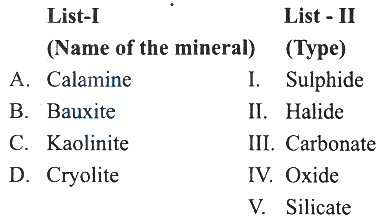
The correct answer isAP EAMCET 2023 Easy - \[
\text { If }\left(1+\frac{3}{1}\right)\left(1+\frac{5}{4}\right)\left(1+\frac{7}{9}\right) \ldots\left(1+\frac{2 n+1}{n^2}\right)=121 \text {, }
\]
then \(n=\)AP EAMCET 2018 Medium