


AP EAMCET · Chemistry · Electrochemistry
When the lead storage battery is in use (during discharge) the reaction that occurs at the anode is
- A \(\mathrm{PbSO}_4(\mathrm{~s})+2 \mathrm{H}_2 \mathrm{O}(\ell) \longrightarrow \mathrm{PbO}_2(\mathrm{~s})+\mathrm{SO}_4^{2-}(\mathrm{aq})+4 \mathrm{H}^{+}(\mathrm{aq})+2 \mathrm{e}^{-}\)
- B \(\mathrm{Pb}(\mathrm{s})+\mathrm{PbO}_2(\mathrm{~s})+2 \mathrm{H}_2 \mathrm{SO}_4(\mathrm{aq}) \longrightarrow 2 \mathrm{PbSO}_4(\mathrm{~s})+2 \mathrm{H}_2 \mathrm{O}(\mathrm{l})\)
- C \(\mathrm{Pb}(\mathrm{s})+\mathrm{SO}_4^{2-}(\mathrm{aq}) \longrightarrow \mathrm{PbSO}_4(\mathrm{~s})+2 \mathrm{e}^{-}\)
- D \(\mathrm{PbO}_2(\mathrm{~s})+\mathrm{SO}_4^{2-}(\mathrm{aq})+4 \mathrm{H}^{+}(\mathrm{aq})+2 \mathrm{e}^{-} \longrightarrow \mathrm{PbSO}_4(\mathrm{~s})+2 \mathrm{H}_2 \mathrm{O}(l)\)
Answer & Solution
Correct Answer
(C) \(\mathrm{Pb}(\mathrm{s})+\mathrm{SO}_4^{2-}(\mathrm{aq}) \longrightarrow \mathrm{PbSO}_4(\mathrm{~s})+2 \mathrm{e}^{-}\)
Step-by-step Solution
Detailed explanation
NO SOLUTION
See the Complete Solution
Get step-by-step explanations for this and 2.5 Lakh+ more JEE, NEET & CET questions.
- Unlock all solutions
- Practice the full chapter
- Track accuracy across PYQs
4.8 rated on Google Play · 14,000+ reviews
More questions from Chemistry
- Match the following :
\(\begin{array}{llll}
\hline & \text{List I} & \text{List II } \\
\hline \text{A.} & \mathrm{BrF}_5 & \text{I.} & A_{B_4} E, \text{see-saw} \\
\hline \text{B.} & \mathrm{SF}_4 & \text{II.} & A B_4 E_2, \text{square planar} \\
\hline \text{C.} & \mathrm{XeF}_4 & \text{III.} & A B_5 E, \text{square pyramidal} \\
\hline \text{D.} & \mathrm{CIF}_3 & \text{IV.} & A B_3 E_2, \mathrm{~T} - \text{shape} \\
\hline & & \text{V.} & A B_5 E_2, \text{square pyramidal} \\
\hline
\end{array}\)
The correct answer isAP EAMCET 2019 Easy - The following graph is obtained for an ideal solution containing a non-volatile solute, \(x\) - and \(y\)-axis represent, respectively
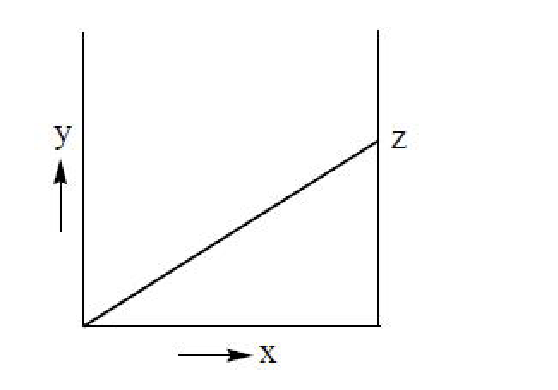 AP EAMCET 2025 Medium
 - In the reaction sequence,
\(\mathrm{C}_2 \mathrm{H}_5 \mathrm{Cl}+\mathrm{KCN} \stackrel{\mathrm{C}_2 \mathrm{H}_5 \mathrm{OH}}{\longrightarrow} X \underset{\Delta}{\stackrel{\mathrm{H}_3 \mathrm{O}^{\oplus}}{\longrightarrow}}$$Y\)
What is the molecular formula of \(Y\) ?AP EAMCET 2003 Easy - The copper halide which does not exist is:AP EAMCET 2019 Hard
- Consider the following
Statement I : \(\mathrm{H}_2 \mathrm{O}_2\) acts as an oxidsing as well as reducing agent in both acidic and basic media.
Statement-II : \(10 \mathrm{~V~} \mathrm{H}_2 \mathrm{O}_2\) sample means it contains \(6 \%,(\mathrm{w} / \mathrm{v}) \mathrm{H}_2 \mathrm{O}_2\).
The correct answer isAP EAMCET 2025 Medium - Identify the reaction in which monobasic and dibasic acids are formed.AP EAMCET 2018 Easy
More PYQs from AP EAMCET
- If the circles \(x^2+y^2+2 \alpha x+2 y-8=0\) and \(x^2+y^2-2 x\) \(+\alpha y-14=0\) intersect orthogonally, then the distance between their centres isAP EAMCET 2024 Easy
- Let \(M=\left[\begin{array}{lll}1 & 2 & 2 \\ 2 & 1 & 2 \\ 2 & 2 & 1\end{array}\right]\) and \(I\) be the identity matrix of order 3 . Then \(M^2-4 M=\)AP EAMCET 2020 Easy
-

\(+\mathrm{Cl}_2 \xrightarrow[4]{\mathrm{FeCl}_3} X \xrightarrow[\text { Na/dry ether }]{\mathrm{R}-\mathrm{X}} \mathrm{Y}\)
Conversion of X to Y is an example ofAP EAMCET 2024 Easy - A copper wire of length \(2.4 \mathrm{~m}\) and an aluminum wire of length \(0.7 \mathrm{~m}\), both having diameter \(2 \mathrm{~mm}\), are connected end to end. When stretched by a load, the obtained elongation is found to be \(0.6 \mathrm{~mm}\).The applied load is (Young's modulus of copper \(=1.2 \times 10^{11} \mathrm{Nm}^{-2}\) and Young's modulus of aluminum \(=0.7 \times 10^{11} \mathrm{Nm}^{-2}\) )AP EAMCET 2022 Medium
- Consider the following changes I and II
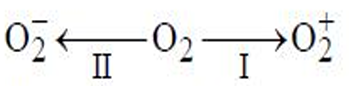
The correct statements about these changes (I) and (II) in accordance with MO theory are
A)In (I) bond order increases by 0.5 from the existing value
B)In (II) bond order decreases by 1.0 from the existing value
C) In both (I) and (II) magnetic property is not changed
D) In both (I) and (II) magnetic property is changedAP EAMCET 2025 Medium - \(\{n(n+1)(2 n+1): n \in Z\} \subset\)AP EAMCET 2005 Easy