


AP EAMCET · Chemistry · Structure of Atom
The ions \(\mathrm{S}^{2-}, \mathrm{Cl}^{-}, \mathrm{K}^{+}, \mathrm{Ca}^{2+}\) are isoelectronic. Their ionic radii show
- A a decrease from \(\mathrm{S}^{2-}\) to \(\mathrm{Cl}^{-}\)and then increase from \(\mathrm{K}^{+}\)to \(\mathrm{Ca}^{2+}\)
- B an increase from \(\mathrm{S}^{2-}\) to \(\mathrm{Cl}^{-}\)and then decrease from \(\mathrm{K}^{+}\)to \(\mathrm{Ca}^{2+}\)
- C a significant decrease from \(\mathrm{S}^{2-}\) to \(\mathrm{Ca}^{2+}\)
- D a significant increase from \(\mathrm{S}^{2-}\) to \(\mathrm{Ca}^{2+}\)
Answer & Solution
Correct Answer
(C) a significant decrease from \(\mathrm{S}^{2-}\) to \(\mathrm{Ca}^{2+}\)
Step-by-step Solution
Detailed explanation
For isoelectronic species, the ionic radii decrease with increase in nuclear charge. So, the cation with greater + ve charge i.e. \(\mathrm{Ca}^{2+}\) will have smaller radius and the anion with greater - ve charge i.e. \(\mathrm{S}^{2-}\) will have a larger radius. \(\because\)…
See the Complete Solution
Get step-by-step explanations for this and 2.5 Lakh+ more JEE, NEET & CET questions.
- Unlock all solutions
- Practice the full chapter
- Track accuracy across PYQs
4.8 rated on Google Play · 14,000+ reviews
More questions from Chemistry
- The general formula of a cycloalkane isAP EAMCET 2020 Easy
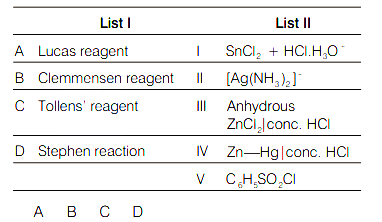
- Match the following
 AP EAMCET 2018 Medium
 - Identify the incorrect statements among the following?
(i) does not react with water
(ii) is hybridized
(iii) is a linear ion
(iv) There is no -bonding in ionAP EAMCET 2021 Easy - When a certain metal was irradiated with light of frequency \(4.0 \times 10^{16} \mathrm{~s}^{-1}\), the photoelectrons emitted had four times kinetic energy as the kinetic energy of photoelectrons emitted when the same metal was irradiated with light of frequency \(2.0 \times 10^{16} \mathrm{~s}^{-1}\). The threshold frequency \(\left(v_0\right)\) of the metal in \(\mathrm{s}^{-1}\) isAP EAMCET 2019 Easy
- Which of the following is not the application of adsorption?AP EAMCET 2023 Easy
- The element with maximum bond-energyAP EAMCET 2021 Easy
More PYQs from AP EAMCET
- If the curves and intersect at right angles, thenAP EAMCET 2021 Medium
- At \(\mathrm{T}(\mathrm{K})\), the vapour pressure of an aqueous solution of a non-volatile solute, whose mole fraction is 0.02 is found to be 34.65 mm Hg. What is the vapour pressure (in mm Hg ) of pure water at the same temperature ?AP EAMCET 2025 Medium
- Suitable conditions to prepare hexachlorobenzene from benzene is/areAP EAMCET 2020 Easy
- A boat of mass \(700 \mathrm{~kg}\) is travelling at a speed of \(24 \mathrm{~ms}^{-1}\) when its engine is shut off. The magnitude of frictional force \(f\) between boat and water is given as \(f=35 v\). Where \(v\) is the speed in \(\mathrm{ms}^{-1}\) and \(f\) is in newton. The speed of boat becomes \(6 \mathrm{~ms}^{-1}\) in time.AP EAMCET 2022 Medium
- There are identical white balls and identical black balls. The number of distinguishable arrangements in a row of all the balls, so that no two black balls are adjacent isAP EAMCET 2021 Easy
- If the total electricity required to deposit 1 mole of a metal \(M\) is equal to that of 10.7 amperes of current for 10 hours. The equivalent weight of the metal is (atomic weight \(=M \mathrm{u}\))AP EAMCET 2022 Medium