


AP EAMCET · Chemistry · Haloalkanes and Haloarenes
Consider the following reaction
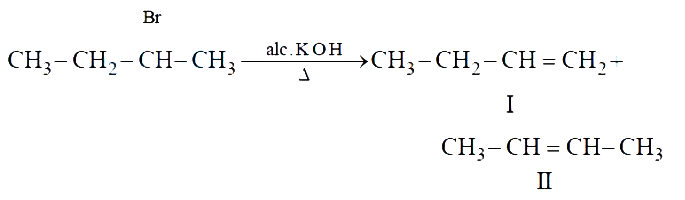
Which of the following statements are correct ?
a. I is the major product of the reaction
b. II is the major product of the reaction
c. Formation of I is in accordance with Saytzeff's rule
d. II is more stable because it is more substituted
- A a,c
- B b,c
- C a,d
- D b,d
Answer & Solution
Correct Answer
(D) b,d
Step-by-step Solution
Detailed explanation
No solution. Refer to answer key.
See the Complete Solution
Get step-by-step explanations for this and 2.5 Lakh+ more JEE, NEET & CET questions.
- Unlock all solutions
- Practice the full chapter
- Track accuracy across PYQs
4.8 rated on Google Play · 14,000+ reviews
More questions from Chemistry
- In the following reaction, \(X\) and \(Y\) are respectively
\[
\mathrm{CH}_3 \mathrm{COOH}+\mathrm{NH}_3 \longrightarrow X \stackrel{\Delta}{\longrightarrow} Y+\mathrm{H}_2 \mathrm{O}
\]AP EAMCET 2002 Medium - In comparison to a \(0.01 \mathrm{M}\) solution of glucose, the depression in freezing point of a \(0.01 \mathrm{M} \mathrm{MgCl}_2\) solution is (Molecular weight of \(\mathrm{MgCl}_2=95\), molecular weight of glucose \(=180\) ).AP EAMCET 2020 Medium
- Le-Chateliar's principle is not applicable toAP EAMCET 2021 Easy
- Which of the following orders are correct against the property given?
\(\begin{array}{lll} \hline \text { (I) } & \text { Dipole moment } & \mathrm{NF}_3 > \mathrm{NH}_3 > \mathrm{BF}_3 \\ \hline \text { (II) } & \text { Covalent bond length } & \mathrm{C}-\mathrm{O} > \mathrm{N}-\mathrm{O} > \mathrm{O}-\mathrm{H} \\ \hline \text { (III) } & \text { Bond order } & \mathrm{C}_2 > \mathrm{B}_2 > \mathrm{He}_2 \\ \hline \end{array}\)AP EAMCET 2019 Easy - Compound \(A\) is prepared by the electrolysis of aqueous solution of \(B\) using Castner- Kellner cell with mercury as cathode and carbon as anode. \(A\) and \(B\) respectively areAP EAMCET 2019 Easy
- What are \(X\) and \(Y\) in the following reaction?
Pent-2-ene \(\underset{\text { (ii) } \mathrm{Zn}_{\mathrm{n} / \mathrm{H}_2 \mathrm{O}}}{\stackrel{\text { (i) } \mathrm{O}_3}{\longrightarrow}} X+Y\)
\begin{array}{ll}\multicolumn{1}{c}{X} & \multicolumn{1}{c}{Y}
\end{array}AP EAMCET 2018 Medium
More PYQs from AP EAMCET
- Match the following :
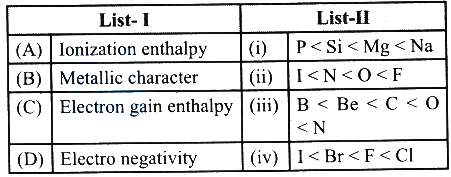
Then the correct match isAP EAMCET 2024 Medium - If \(y=x+\sqrt{2}\) is a tangent to the hyperbola \(\frac{x^2}{a^2}-\frac{y^2}{2}=1\), then equations of its directrices areAP EAMCET 2024 Easy
- If \(2 x^2-3 x y+y^2+x+2 y-8=0\), then \(\frac{d y}{d x}\) is equal toAP EAMCET 2007 Easy
- Which of the following will form an ideal solution?AP EAMCET 2021 Easy
- \(\int_{-\pi / 2}^{\pi / 2} \sin |x| d x\) is equal toAP EAMCET 2008 Easy
- Observe the following reactions
I. \(\mathrm{N}_2(\mathrm{~g})+3 \mathrm{H}_2(\mathrm{~g}) \xrightarrow[\substack{773 \mathrm{~K} \\ 200 \mathrm{~atm}}]{\mathrm{X}} 2 \mathrm{NH}_3(\mathrm{~g})\)
II. \(\mathrm{CO}(\mathrm{g})+\mathrm{H}_2 \mathrm{O}(\mathrm{g}) \frac{\mathrm{Y}}{673 \mathrm{~K}} \rightarrow \mathrm{CO}_2(\mathrm{~g})+\mathrm{H}_2(\mathrm{~g})\)
III. \(\mathrm{CH}_4(\mathrm{~g})+\mathrm{H}_2 \mathrm{O}(\mathrm{g}) \xrightarrow[1270 \mathrm{~K}]{\mathrm{Z}} \mathrm{CO}(\mathrm{g})+3 \mathrm{H}_2(\mathrm{~g})\)
Catalysts X, Y, Z respectively areAP EAMCET 2025 Medium