


AP EAMCET · Chemistry · s Block Elements
Calcium phosphide reacts with water to form \(\mathrm{Ca}(\mathrm{OH})_2\) and \(X\). When \(X\) is passed into \(\mathrm{CuSO}_4\) solution. \(Y\) and \(\mathrm{H}_2 \mathrm{SO}_4\) are formed. What is \(Y\) ?
- A \(\left[\mathrm{Cu}\left(\mathrm{PH}_3\right)_4\right]^{2 *}\)
- B \(\left[\mathrm{Cu}\left(\mathrm{PH}_3\right)_6\right]^{2+}\)
- C \(\mathrm{Cu}_3 \mathrm{P}_2\)
- D \(\mathrm{CuHPO}_4\)
Answer & Solution
Correct Answer
(C) \(\mathrm{Cu}_3 \mathrm{P}_2\)
Step-by-step Solution
Detailed explanation
Calcium phosphide reacts with water to form calcium hydroxide and phosphine.…
See the Complete Solution
Get step-by-step explanations for this and 2.5 Lakh+ more JEE, NEET & CET questions.
- Unlock all solutions
- Practice the full chapter
- Track accuracy across PYQs
4.8 rated on Google Play · 14,000+ reviews
More questions from Chemistry
- What is \(Z\) in the following reactions?
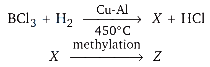 AP EAMCET 2012 Hard
 - If the kinetic energy of an electron of mass \(9.0 \times 10^{-31} \mathrm{~kg}\) is \(8.0 \times 10^{-25} \mathrm{~J}\), the wavelength of this electron in \(\mathrm{nm}\) isAP EAMCET 2018 Medium
- Which of the following is not explained by hyperconjugation?AP EAMCET 2021 Easy
- When ethanol is treated with sulphuric acid at \(413 \mathrm{~K}\) the reaction involved in it isAP EAMCET 2022 Medium
- Consider the following statements for a gold sol
(I) It is macromolecular colloid
(II) It is a lyophobic sol
(III)It is a negatively charged sol
(IV) It is a multimolecular colloid
(V) It is an associated colloid
The correct statements areAP EAMCET 2023 Easy - If the \(\mathrm{pH}\) of a buffer solution containing \(0.1 \mathrm{M}\) of monoacidic base and \(0.01 \mathrm{M}\) of its salt is 10.5 , the \(\mathrm{p} K_a\) of conjugate acid isAP EAMCET 2019 Medium
More PYQs from AP EAMCET
- \(\lim _{x \rightarrow 0} \frac{\tan x-\sin x}{x^2}\) is equal toAP EAMCET 2010 Easy
- Calculate enthalpy for formation of ethylene from the following data
(I) \(\mathrm{C}_{\text {(graphite) }}+\mathrm{O}_2(\mathrm{~g}) \longrightarrow \mathrm{CO}_2(\mathrm{~g})\)
\(\Delta H=393.5 \mathrm{~kJ}\)
(II) \(\mathrm{H}_2(g)+\frac{1}{2} \mathrm{O}_2(g) \longrightarrow \mathrm{H}_2 \mathrm{O}(l)\);
\(\Delta U=-256.2 \mathrm{~kJ}\)
(III) \(\begin{array}{r}\mathrm{C}_2 \mathrm{H}_4(g)+3 \mathrm{O}_2(g) \rightarrow 2 \mathrm{CO}_2(g)+2 \mathrm{H}_2 \mathrm{O}(l) ; \\ \Delta H=-1410.8 \mathrm{~kJ}\end{array}\)AP EAMCET 2007 Easy - Gelly is a colloidal solution ofAP EAMCET 2012 Easy
- Xenon best reacts withAP EAMCET 2021 Easy
- If \(x, y, z\) are all positive and are the \(p\) th, \(q\) th and \(r\) th terms of a geometric progression respectively, then the value of the determinant
\(\left|\begin{array}{lll}
\log x & p & 1 \\
\log y & q & 1 \\
\log z & r & 1
\end{array}\right| \text { equals }\)AP EAMCET 2009 Medium - If \(f(x)=\frac{x}{1+|x|}\), for \(x \in R\), then \(f^{\prime}(0)\) is equal to :AP EAMCET 2003 Easy