


AP EAMCET · Chemistry · Thermodynamics (C)
At the temperature \(T(\mathrm{~K})\) for the reaction \(X_2 \mathrm{O}_4(l) \rightarrow 2 X \mathrm{O}_2(g) \Delta U=x \mathrm{~kJ} \mathrm{~mol}^{-1}\), \(\Delta S=y \mathrm{JK}^{-1} \mathrm{~mol}^{-1}\). Gibbs energy change for the reaction is (Assume \(X_2 \mathrm{O}_4, X_2\) are ideal gases) \(\Delta U=x \mathrm{~kJ} \mathrm{~mol}^{-1}, \Delta S=y \mathrm{JK}^{-1} \mathrm{~mol}^{-1}\)
- A \(1000 x+2 R(T-y) \mathrm{J} \mathrm{mol}^{-1}\)
- B \(1000 x+T(2 R-y) \mathrm{J} \mathrm{mol}^{-1}\)
- C \(x+T(2 R-y) \mathrm{J} \mathrm{mol}^{-1}\)
- D \(x+2 R(T-y) \mathrm{J} \mathrm{mol}^{-1}\)
Answer & Solution
Correct Answer
(B) \(1000 x+T(2 R-y) \mathrm{J} \mathrm{mol}^{-1}\)
Step-by-step Solution
Detailed explanation
But, \(\quad H=U+p V\) or \(H=U+n R T\) From equation (i) and (ii) we get \[ \Delta G=\Delta U+\Delta n R T-T \Delta S \] But, for given reaction. \(\Delta n=2, \Delta U=1000 \times \mathrm{J} / \mathrm{mol}\) and \[ \Delta S=y \mathrm{~J} \mathrm{~K}^{-1} \mathrm{~mol}^{-1} \]…
See the Complete Solution
Get step-by-step explanations for this and 2.5 Lakh+ more JEE, NEET & CET questions.
- Unlock all solutions
- Practice the full chapter
- Track accuracy across PYQs
4.8 rated on Google Play · 14,000+ reviews
More questions from Chemistry
- The pH of a solution of \(\mathrm{H}_2 \mathrm{O}_2\) is 6.0. Some chlorine gas is bubbled into this solution. Which of the following is correct?AP EAMCET 2005 Easy
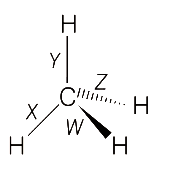
- In the following three dimensional structure of \(\mathrm{CH}_4\), the bonds are labelled as \(W, X, Y\) and \(Z\). The bonds projecting out of the plane are:
 AP EAMCET 2018 Medium
 - The set of molecules in which the central atom is not obeying the octet rule isAP EAMCET 2022 Easy
- Which reaction among the following gives nascent oxygen?AP EAMCET 2021 Medium
- Observe the following statements :
a) The basic strength of \(\mathrm{Lu}(\mathrm{OH})_3, \mathrm{Gd}(\mathrm{OH})_3\) and \(\mathrm{Ce}(\mathrm{OH})_3\) follow the order :
\(\mathrm{Ce}(\mathrm{OH})_3>\mathrm{Gd}(\mathrm{OH})_3>\mathrm{Lu}(\mathrm{OH})_3\)
b) \(\mathrm{O}^{2-}, \mathrm{N}^{3-}, \mathrm{O}^{-}\)and \(\mathrm{Mg}^{+}\)are isoelectronic species
c) The sizes of \(\mathrm{Zr}\) and \(\mathrm{Hf}\) are approximately same
The correct statements areAP EAMCET 2017 Easy - When \(30 \mathrm{~mL}\) of \(\mathrm{H}_2\) reacts with \(20 \mathrm{~mL}\) of \(\mathrm{O}_2\) to form water, what is leftover when the reaction ends?AP EAMCET 2020 Easy
More PYQs from AP EAMCET
- Let \(f: \mathbf{R} \rightarrow \mathbf{R}\) be a continuous function such that for any two real numbers \(x\) and \(y\), \(|f(x)-f(y) \leq 10| x-.\left.y\right|^{201}\), thenAP EAMCET 2020 Hard
- If a real valued function \(f\) is defined by \(f(x)=\) \(\frac{a x+\sqrt{a^2-x^2}}{b x}\), then \(f\) isAP EAMCET 2023 Easy
- A stone is dropped from the top of a tower of height \(\mathrm{h}=60 \mathrm{~m}\). Simultaneously another stone is projected vertically upwards from the foot of the tower. They meet at a height \(\frac{2 \mathrm{~h}}{3}\) from the ground level. The initial velocity of the stone projected upwards is \(\left(\mathrm{g}=10 \mathrm{~ms}^{-2}\right)\).AP EAMCET 2017 Easy
- If \(\int \frac{\sqrt[4]{x}}{\sqrt{x}+\sqrt[4]{x}} d x=\frac{2}{3}\left[A \sqrt[4]{x^3}+B \sqrt[4]{x^2}+C \sqrt[4]{x}+D \log (1+\sqrt[4]{x})\right]+K\) then \(\frac{2}{3}(A+B+C+D)=\)AP EAMCET 2024 Hard
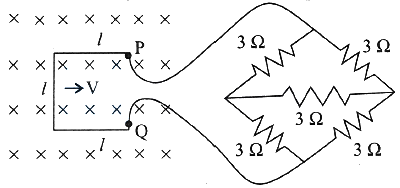
- A metallic wire loop of side \((l) 0.1 \mathrm{~m}\) and resistance of \(1 \Omega\) is moved with a constant velocity in a uniform magnetic field of \(2 \mathrm{Wm}^{-2}\) as shown in the figure. The magnetic field is perpendicular to the plane of the loop. The loop is connected to a network of resistors. The velocity of loop so as to have a steady current of 1 mA in loop is
 AP EAMCET 2024 Easy
 - The process which invovles the treatment of the ore with a suitable reagent so as to make it soluble but not impurities is calledAP EAMCET 2023 Easy